
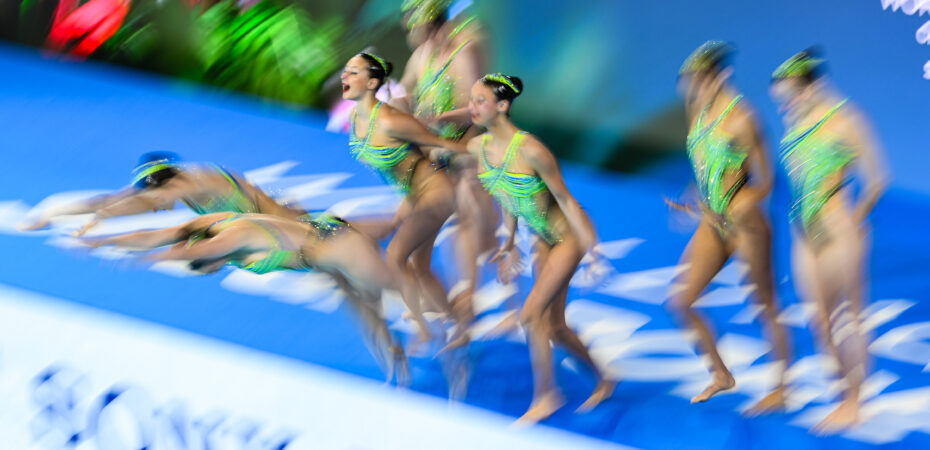
Updates to the rules for the 2026 season are officially up on the World Aquatics (AQUA) website. Ahead of the year’s first World Cup, we’ve summarized some of the key changes to factors, hybrid bonuses, hybrid catalogue, and pair and team acrobatics. Rationale for these revisions generally includes improvement of clarity and consistency, as well as incorporation of feedback from coaches, athletes, and officials.
Overall, the changes for 2026 are relatively minor, and many fall into the category of “housekeeping” — clarifying language, tightening definitions, and aligning interpretation. For casual viewers, the differences may not be immediately noticeable when watching routines, and they are unlikely to be as visually striking as the shifts seen over the past three seasons.
That said, these adjustments still fine-tune the existing framework, with a continued push toward greater artistry and creativity.
Please note that this is a summary of some of the most significant changes and not an exhaustive list. More specifics can be found in the updated rules, manuals, and appendices.
No New Technical Required Elements or Figures
Before diving into what is changing, it’s worth noting what isn’t — and, historically, should have. In previous Olympic cycles, the Technical Required Elements (TREs) and Figures across all age groups were updated following the World Championships held in the year after the Olympic Games. By that logic, changes would normally have been introduced after Singapore, taking effect for the 2026 season.
This time, however, that update never came. Athletes will perform the same TREs and Figures in 2026 as they did in 2025.
The reasoning is essentially to give everyone a rest. Per officials in AQUA’s Technical Artistic Swimming Committee (TASC), after three years under the new system — and navigating significant annual adjustments as its early issues were worked through — one season without any major changes gives athletes, coaches, and officials a chance to pause, settle, and consolidate their understanding of the framework.
Work on future TREs and Figures is already underway, with expert committees developing proposals for the following seasons. While these changes are in the works, 2026 will be a year of stability rather than overhaul.
Adjusted Factors
Perhaps the most exciting change to the rules this year pertains to the factors.
First, it’s worth a quick reminder of how factors work in this open-ended scoring system. Every routine score is made up of two parts: Elements and Artistic Impression (AI). Both of these is broken down into smaller categories. For example, Artistic Impression includes Choreography and Musicality, Performance and Transitions. Each of these categories gets an average score, which is then multiplied by a factor to simply control how much each of those categories counts in the final score. This therefore helps keep a balance between difficulty content and artistry.
-
Junior / Senior
In the junior and senior categories, the existing factors for all technical routines, as well as the acrobatic team routine, appear to be working as intended, so those will remain unchanged.
In free routines, however, the breakdowns within AI have been adjusted significantly, and Elements factors have also been lowered in team and mixed duet.
Since the introduction of the new system, AQUA’s goal for free routines (i.e. Solo, Duet, Team) has been a 50/50 balance between Elements and AI scores. In practice, however, it was often closer to 60/40. Early on, wide variations in Degree of Difficulty and officials adapting to the system made calibration challenging. Now, with DD limits better understood and scoring more stabilized, adjustments have been made to inch closer to that intended 50/50 balance.
Free Mixed Duet has always been treated slightly differently, with a heavier emphasis on AI right from the start and a 50/50 split never being the objective. Even so, further adjustments have also been introduced to continue along that path and bring the event closer to a 40/60 balance, or even 35/65.
Moving into 2026, Transitions are now weighted the most, accounting for nearly half (45%) of the AI score, while Choreography/Musicality and Performance split the remaining 55% (each is worth 27.5% of the AI score).
Transitions are the linking actions and movements occurring before and after the judged Elements. That means propulsion techniques, strokes, ballet leg combinations, flexibility surface actions, surface pattern changes, or pair assisted actions. Judges consider the execution (50%) and complexity (50%) of these transitions. The variety and creativity of the routine’s transitions is considered with the Choreography and Musicality score. The athlete’s ability to perform a larger variation of complex transitional movements, showing constant movement of many different body parts in an excellent manner will affect the Transitions score.
As a result, transitions can no longer be treated as filler. In the past, they could be clean, fluid, and visually pleasing without being particularly complex, and the impact on the score was limited. Now, with transitions carrying significantly more weight, a lack of complexity or content may be far more costly. Well-executed but simple transitions will no longer be enough to be in a very good or excellent score range. Instead, programs will be rewarded for purposeful and demanding connective movement — and penalized more heavily when that content is missing.
-
Youth
In Youth, nearly all factors have been adjusted to achieve the same intended 50/50 balance for Solo, Duet and Team, and 40/60 for the Free Combination routine. Mixed Duet also sees changes to achieve the 35-40/60-65 split as in the junior and senior categories.
The weight of Transitions has been increased across the board as well, also accounting for 45% of the AI score. Elements factors have generally been lowered in virtually all events.
Similarly, the Figures weight has been raised in Solo, Duet and Team to align with the 40% target of the total score; remember that in Youth, final rankings are determined by combining the routine score with the Figures score (with the exception of combo).
-
U12
All U12 events’ factors will also remain unchanged, largely because AQUA does not have sufficient data to make a fully informed decision. Instead, the community is highly encouraged to adapt to local needs for this age group.
Bonuses
In the past, teams have been allowed to declare an unlimited number of pattern changes, worth 0.2 each, in each free hybrid.
Now, pattern changes are capped at six per hybrid, meaning that teams can only add 1.2 to a free hybrid’s difficulty via this bonus.
Hybrid Catalogue & DD Table
Changes to the Hybrid Catalogue and DD Table are for the most part small, though undoubtedly important.
In the Thrusts family (T), the definition of “thrust with flexibility” (as seen in T8) has been expanded to include back flexibility movements. For back flexibility movements like a back arch to pass, athletes must achieve a 45° angle backwards with the legs.
AQUA’s document summarizing the rule changes includes a statement about unbalanced rotations in the Twists family (R) that include simultaneous turning, clarifying that DTCs watch swimmers’ knees to determine the number of wall-to-wall 360° rotations executed.
For the Airborne Weight family (A), lifts to single or double leg vertical positions with a simultaneous rotation of 180° (A2b, A4b) or 360° (A4a, A5) is now in alignment with the RCB/RC1 wording, which stipulates that the legs must not reach VP before rotating at least ¾ of the rotation — or 135° and 180°, respectively. This differs from last season, when “gradual” meant that at the halfway point of the rotation, the legs had to be at 45° or lower.
The same is true for movements in the Flexibility family (F) that join or lift while rotating: F6c, F8a, F9, and F10. The hybrid catalogue now states that the join or lift must not finish before at least ¾ of the declared rotation has been completed.
The more advanced Flexibility movements have received additional attention, particularly F7, F9, and F10, all of which begin from a surface arch position. Not only must the rotations in F9 and F10 adhere to the manual’s new definition of “gradual,” but the surface arch definition has also been better defined. For F7, F9, and F10, the arch position must occur at the surface of the water and not airborne. Additionally, the legs may only be 30° apart.
Another notable change for the Flexibility family is the new height requirement for knight positions: Athletes must now achieve a height of at least 5.5 (kneecap) in order for the element to pass, meaning that having the kneecap fully underwater would constitute a basemark. In previous years, a minimum height of 6.5 (above the knee) was required.
Finally, in the Connections family (C), restrictions have been added to the duet and mixed duet events. Previously, connections followed the same guidelines as the other hybrid families: in each hybrid, no more than five declarations per family, and no more than three declarations per technique. Now, however, duets and mixed duets are only allowed two declarations per technique in the connections family — though a total of five connections per hybrid are still permitted.
New Pair Acrobatics & Clarifications
Besides the addition of three new pair acrobatics (#32, #37, and #47), several existing descriptions have been clarified in the pair acro catalogue, including those for #8, #23, #28, #31, and #35.
Twist allowances for pair acrobatics have been revised: For declared twists of 360° or less, 90° less than declared will go to basemark. Rationale for this change included the alignment with team acrobatics as well as the previous 180° allowance having been overly generous, making it difficult for DTCs to distinguish between 180° and 360° twists in pair acros. Once again, it’s better to over-rotate than under-rotate.
Options for declaring flexibility in pair acros has also been updated to align with the flexibility positions allowed in Groups A and B in team acrobatics. In addition to split/oversplit positions, athletes may perform the following (with a 45° allowance for all positions):
From group B – can be used for lifts head-up (“L”) and its variation where flexibility is required: Vertical split (“vs”), glass (“gl”), sail (“sa”), needle (“ne”), eye (“ey”), turtle (“tu”), split (“spl”)
From group B – can be used for lifts head-down (“L!”) and its variation where flexibility is required: Willow (“wi”), owl (“ow”), marlin (“ma”) and knights with back leg bent so toes touch the water
From group A – can be used for throws/jumps (“W”/”J”) and its variation where flexibility is required: Split (“sp”), jay (“ja”), ring (“rg”)
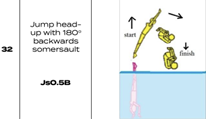
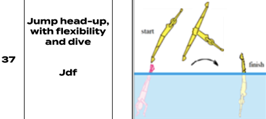
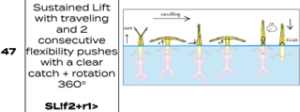
Pair assisted actions have also been clarified:
“In pair assisted actions, the bottom (base) swimmer may remain under the surface of the water or on the surface, but the featured swimmer remains close to the surface (obviously not a Pair Acro lift, throw or jump). ‘Boost-type’ assisted movements are considered as pair assisted actions. Coaches must ensure pair assisted actions do not meet a pair acrobatic definition.”
New Team Acrobatics & Clarifications
The team acrobatics catalogue now includes new visuals, simpler wording in descriptions, and several new charts and tables meant to provide ease for quick reference of the rules.
Notably, the definition of the “JUMP” bonus in Group C — which in the past caused some confusion — has been clarified to mean fully airborne (i.e. the featured swimmer must completely disconnect from the base(s) for the bonus to be considered a jump).
New acrobatic movements have also been added to the catalog — examples include the “Thr>StH>1F” in Group C, in which the featured swimmer is thrown from a first formation onto a second head-down Stack formation and lands one-foot-to-one-foot before stepping with one foot onto a third formation (also a head-down Stack).
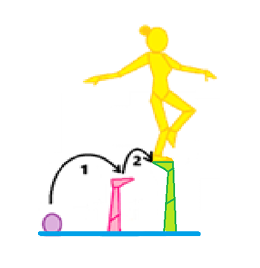
Due to the overuse of certain bonuses for Group P acrobatics, the existing definition of “must not repeat the same acrobatic” has been updated to include a limitation on bonuses. While Group P already had the most restrictions — with teams unable to repeat constructions, type of connection, or positions — the addition of the rule that bonuses may not be repeated means that teams must perform entirely unique platform acrobatics within a routine.
Youth & Junior Apnea Limits (European Aquatics)
European Aquatics will continue to apply apnea limits in 2026, expanding a policy that was already in place for Juniors to now include the Youth category. While apnea limits were introduced for Juniors last season, this marks the first time they will be implemented for Youth — a logical next step, particularly given that there was no European Youth Championships last year, and that the 2024 season still operated under the former AQUA apnea rule (that included the infamous 40-point bonus).
In the Junior category, the rules remain unchanged. For athlete safety, apnea time limits will continue to apply to all free hybrids across all junior events from January 2026 onward. A basemark will be applied to any free hybrid exceeding an apnea time of 25 seconds.
For Youth, apnea time limits also apply to all free hybrids. If a free hybrid exceeds 21 seconds, it will receive a basemark.
Such apnea limits have not been implemented by World Aquatics for their sanctioned events.
ARTICLE BY MARIKIT FLORES AND CHRISTINA MARMET
Cover photo: Andrea Staccioli / Deepbluemedia / Insidefoto
If you’ve enjoyed our coverage, please consider donating to Inside Synchro! Any amount helps us run the site and travel costs to cover meets during the season.
[…] Nota: esta es una traducción y adaptación del Artículo Original de Inside de Sinchro […]