
Fukuoka 2023 called: it wants its basemarks back.
The first World Cup of the season is officially in the books, and while it’s early in the year and no one is looking to peak in February, Medellin delivered… a lot. Just maybe not in the way we expected.
Let’s face it, there were a lot of basemarks. Of 114 finished routines, only 22 were clean. That’s not even a 20% success rate. At a World Cup.
Some mistakes were obvious, like a missing turn in a technical required element, or a featured swimmer not fully clearing the water on a pair acro. But many of the basemarks were far harder to detect, especially for the regular eye following along on a livestream (granted, with changing shots during the routines). So yes, it weirdly felt like the first few months of the new system all over again.
The competition was already off to a stormy start quite literally, as the first two days were significantly delayed because of weather conditions. Add to that the fact that Medellin sits at 1,500 meters above sea level, and you have another layer to consider.
But anyways. Let’s start with the good.
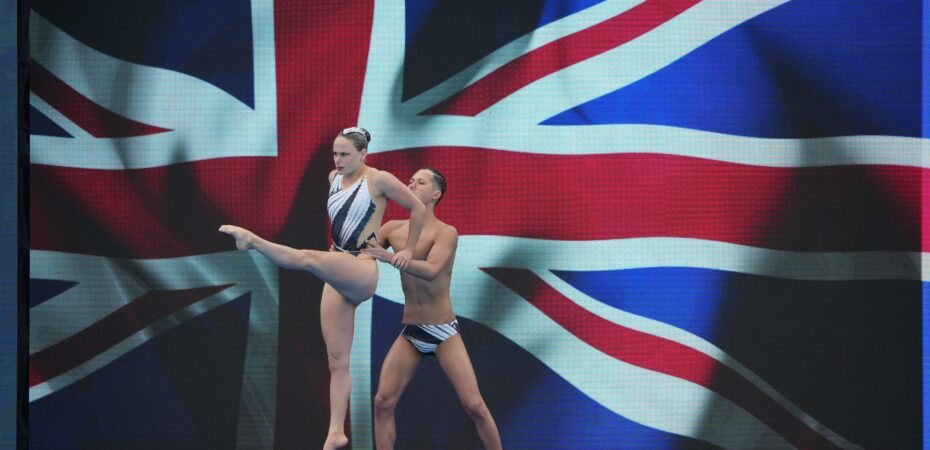
Great Britain made the trip to Colombia more than worthwhile: three events, three golds. Ranjuo Tomblin left Medellin with wins in the men’s technical solo, and was joined by Isabelle Thorpe to clinch the top spot in the technical and free mixed duets. Their new technical mixed duet to “Magalenha” by Sergio Mendes already looks sharp and confident, especially for a February debut, and these two are clearly an outstanding pairing for the country.
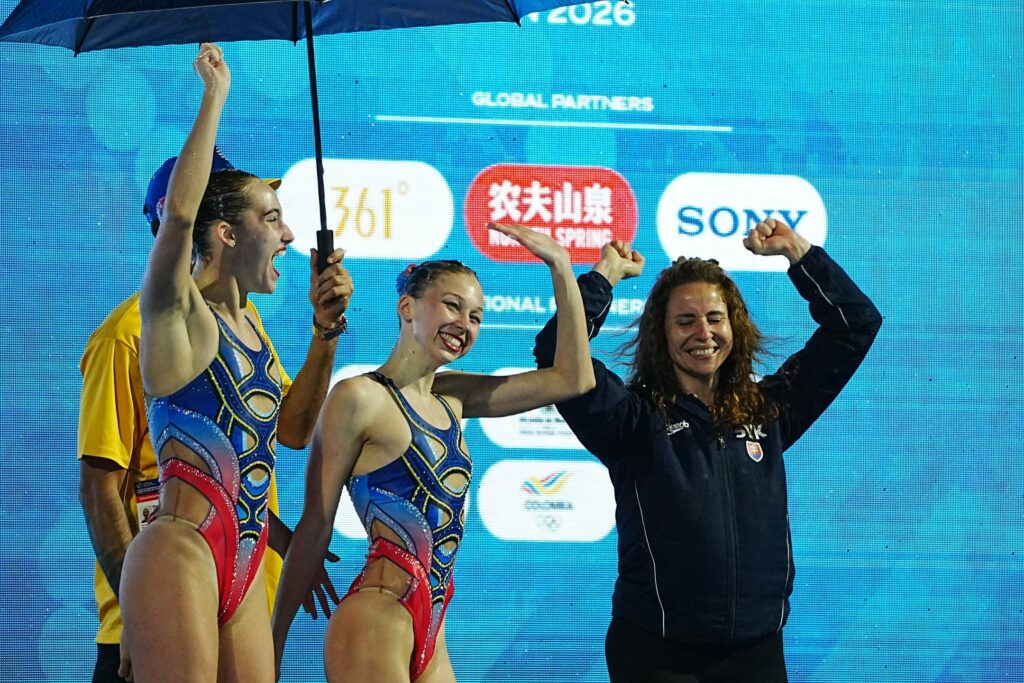
Slovakia delivered one of the most impressive outings of the weekend. Zofia Strapekova secured silver in technical solo with an impeccable swim to “Awa Y’okeyi” by Papa Wemba, themed around love. The routine was sharp, precise and looked remarkably light on the water, with strong heights and clean execution.
Paired with Lea Anna Krajcovicova, the two claimed silver in technical duet and bronze in free duet, finishing ahead of several more established senior pairs or from traditionally dominant artistic swimming nations. It was a statement performance that signals real upward momentum, and makes them a pair to watch closely this season.
Germany also opened its season in strong fashion, claiming three medals out of four possible, one of each color, and also unveiling three new choreographies. Klara Bleyer debuted a new technical solo, “Tribute to Sebastian Bach,” but suffered a strange fluke in her final technical required element, missing a 180 turn. Still, it was enough for bronze. In free solo, where she is the reigning European Champion, she kept her “Space” choreography from last season and earned silver.
She was joined by Amelie Blumenthal Haz in technical duet, where they unveiled a new “Stone Age” routine to earn gold with the highest degree of difficulty at 37.40. They also debuted their new free duet, “Peace in the World,” which ranked fourth.
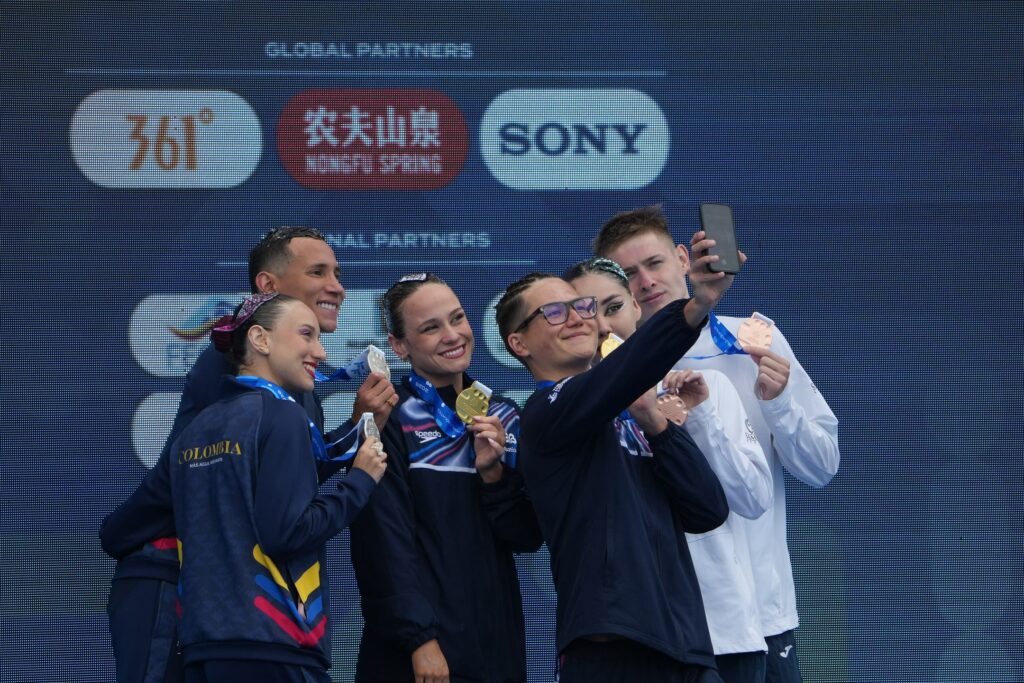
Kazakhstan left Medellin with six medals, including two golds and the most of any country. Eduard Kim returned to free solo for the first time since the 2023 World Championships to claim the win with a new “Dracula” choreography, which allows his artistry and interpretation to fully shine. The nation also captured gold in free team, silver in acrobatic team, bronze in both mixed duets as well as the men’s technical solo.
In technical mixed duet, the young Kazakh pair of Yasmina Islamova and Aldiyar Ramazanov notably debuted a full twist, a remarkable opening acrobatic move with a 2.6 DD. It is a newly invented pair acro, not yet in the catalogue, meaning it belongs exclusively to them for a year and nobody else can declare it.
Canada’s Audrey Lamothe started off her 2026 season quite strong as she swept both solo events. In free solo, she was one of only two athletes to avoid a basemark with her choreography set to the song “Tourner dans le vide” by Indila. In technical solo, she presented a new routine, performing to “L’amore Sei Tu,” the Italian interpretation of “I Will Always Love You.” Canada also added bronze in technical team.
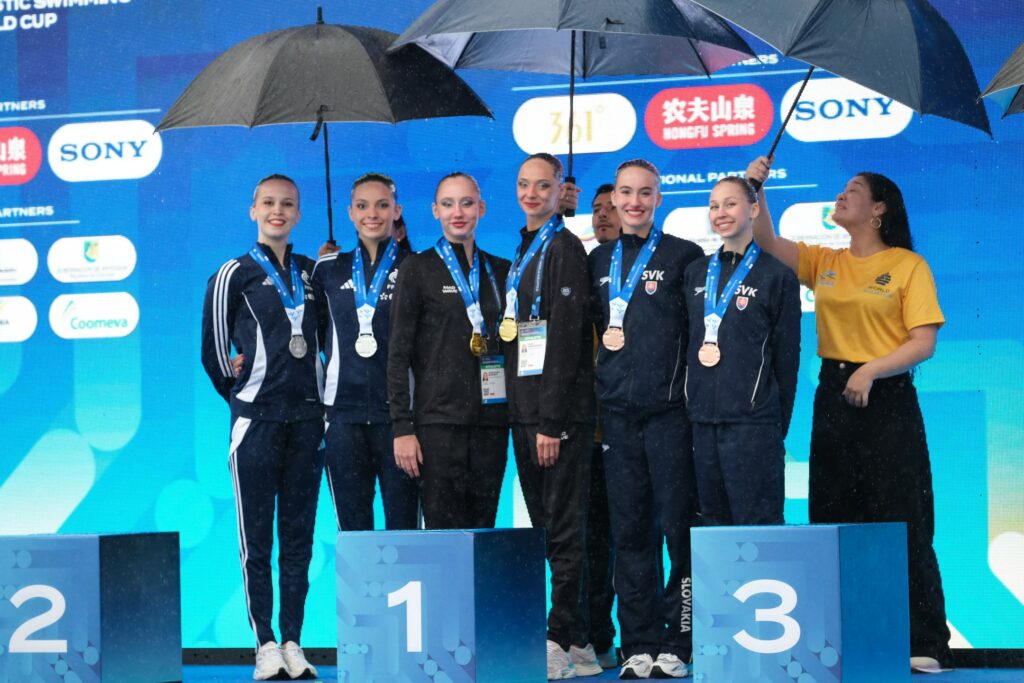
Continuing with soloists, Vasilina Khandoshka, competing as Neutral Athlete A, once again demonstrated her range. Her new technical solo to Marilyn Manson’s “Sweet Dreams” showcased her willingness to push musical boundaries, and her “Mummy” free solo remains one of the more theatrical programs in the field. She won bronze in the latter, but most notably secured the top artistic impression scores in both events.
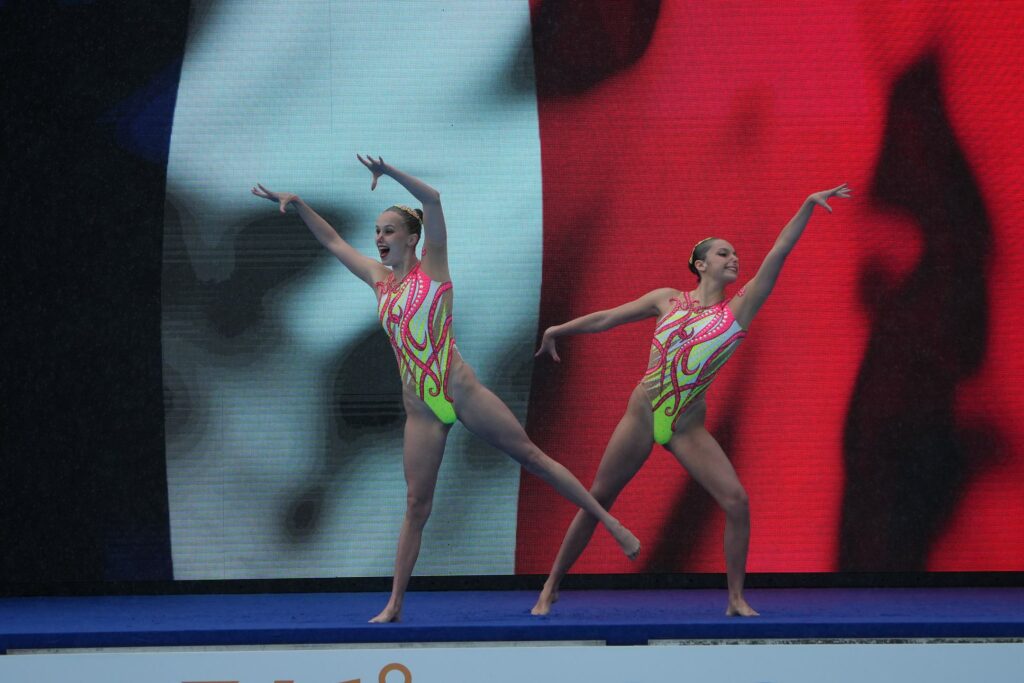
Laelys Alavez and Romane Lunel of France also left Medellin with some silverware, a great season opener for this fairly new pairing. They claimed silver in free duet with their “Octopus” routine, and bronze in technical duet with their new “Heart” choreography.
For Neutral Athletes B, also only competing in duet here, the meet marked the debut of two new pairings. In technical duet, Mayya Doroshko swam with Elizaveta Minaeva, and they unveiled a new choreography set to the heavy rock piece “Rising Force” by Yngwie Malmsteen. The routine is fast-paced and sharp, but unfortunately one of them briefly lost her place in the choreography, resulting in significant synchronization deductions. While they also suffered two basemarks, it was encouraging to see Minaeva back in this event for the first time since her junior days in 2018.
The free duet proved less punishing. Doroshko and Aleksandra Shmidt, making her international debut, retained last year’s “Split Personality” choreography and posted a massive 62.15 DD, though a basemark on the first hybrid limited the final score. Even so, one basemark was better than what much of the field managed, and the pair won gold there.
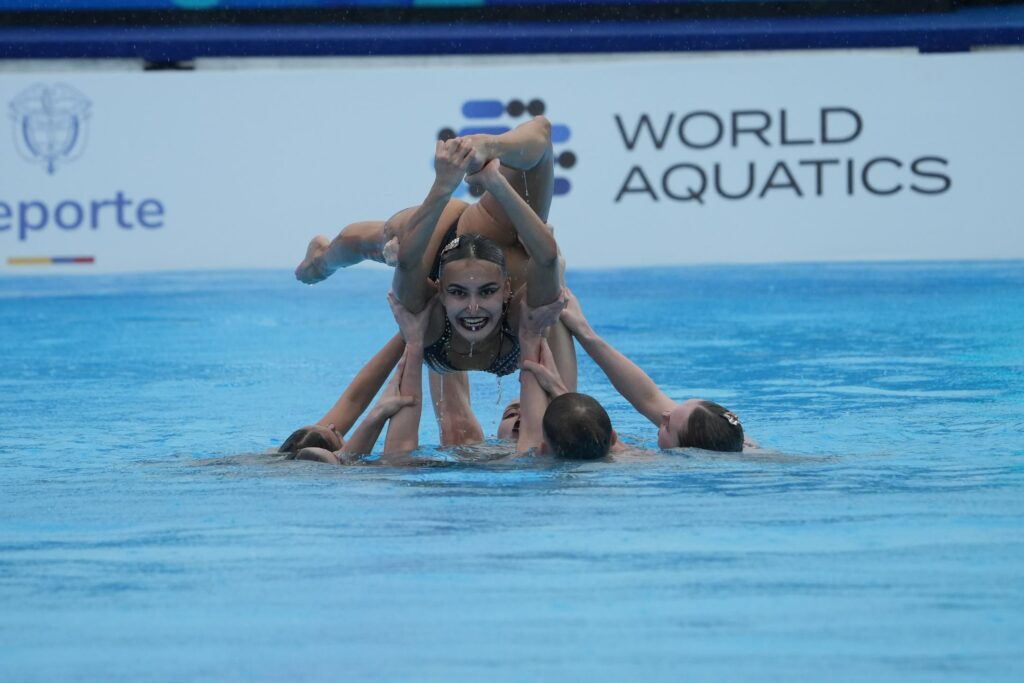
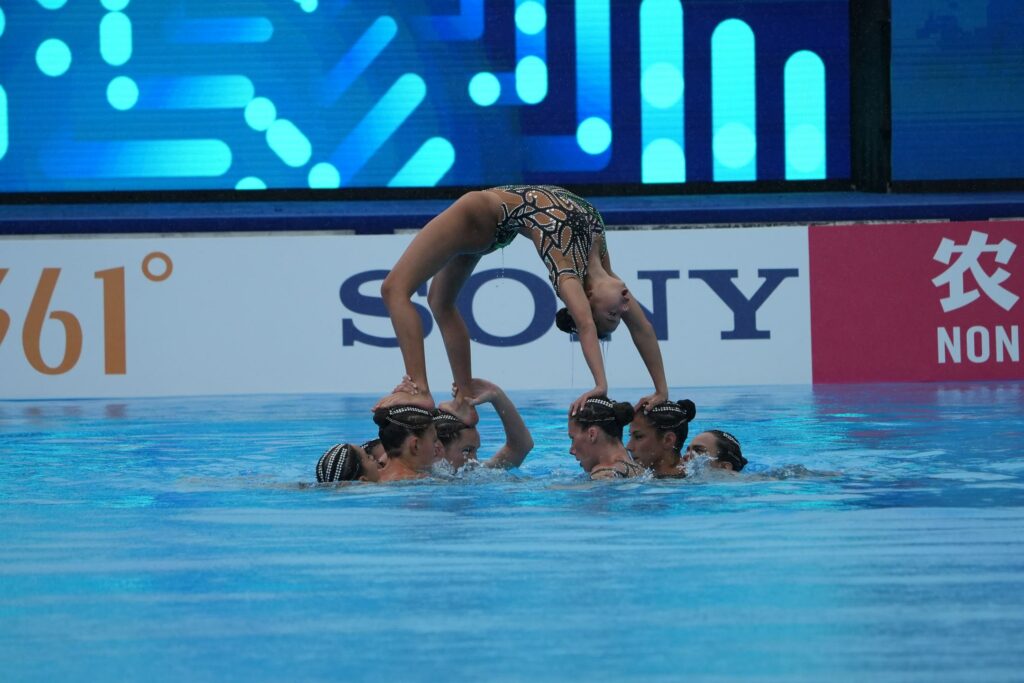
The United States earned silver in technical team with a new routine set to Beyoncé’s “Ya Ya”, and gold in acrobatic team with its tried-and-tested “Sorceresses.” T
wo new American duets — presumably senior and junior — both performed to “Dream On” by Aerosmith. Anita Alvarez and Jaime Czarkowski competed together in duet for the first time, but unfortunately suffered two basemarks.
Mexico claimed gold in technical team with its new “Bollywood” routine. The theme may not be the most original, but it was well executed. Diego Villalobos added a silver in the men’s technical solo and in the technical mixed duet alongside Nayeli Mondragon.
Host nation Colombia delighted the crowd with silver in free mixed duet and free team, and bronze in acrobatic team and in free solo for newcomer Nicolas Tascon in free solo. The atmosphere each time Colombia reached the podium reflected exactly what a first South American World Cup stop should feel like, despite the heavy rainfalls.
And now, the uncomfortable part.
Three athletes in Medellin experienced health issues during the competition, convulsing mid-routine or requiring assistance once they finished. A few weeks earlier, at Russian Junior Nationals, similar scenes unfolded, to my dismay as a viewer, with athletes convulsing in the water, passing out before reaching the wall, or having a mental block before a hybrid and not executing it at all.
And if we are being honest, this did not suddenly start this season. It has been building for a while now, everywhere. Still, it feels like we are opening the year on a dangerous, slippery slope.
It is deeply unsettling to watch young athletes appear oxygen-deprived in pursuit of points, caught in what increasingly resembles a bidding war for higher and higher difficulty (often at the expense of execution). In technical routines especially, where so much difficulty is concentrated into one or two free hybrids, the physical demand is immense. When everyone is still chasing the highest possible DD, something eventually has to give.
Athletes deserve to approach routines with confidence, not fear. European Aquatics has introduced apnea time limits for all free hybrids in youth and junior categories, and perhaps that conversation needs to expand both geographically and across age groups. Or maybe it is about more global limits within a routine. Maybe it is about reconsidering the current limitations which are plausibly not working well. Maybe it is about automatic consequences for the delegation if an athlete shows visible signs of distress in the water. Maybe it is a combination of measures. I don’t have the answer, but what is clear is that the current trajectory is raising legitimate safety concerns.
Altitude in Medellin almost certainly played a role. But multiple athletes (not even accounting for what may have happened in training) experiencing visible health distress in one meet, regardless of the cause, is not something to dismiss lightly. Whether it is difficulty, environmental factors, preparation methods, or something else entirely, it warrants reflection.
Honestly, it is becoming increasingly difficult to ignore the reality that we are seeing more athletes feel unwell during or immediately after routines. Nobody — nobody — wants to watch a sport where there is a genuine chance of witnessing this. And no parent wants their child competing in a sport where these situations are starting to feel common, whether it be at international or local competitions.
Difficulty can be adjusted. Factors can be recalibrated. Athlete safety — and the integrity of the sport itself — cannot however be treated as collateral damage in the evolution of the sport.
ARTICLE BY CHRISTINA MARMET
Cover photo: Federacion Colombiana de Natacio/ World Aquatics
If you’ve enjoyed our coverage, please consider donating to Inside Synchro! Any amount helps us run the site and travel costs to cover meets during the season.