
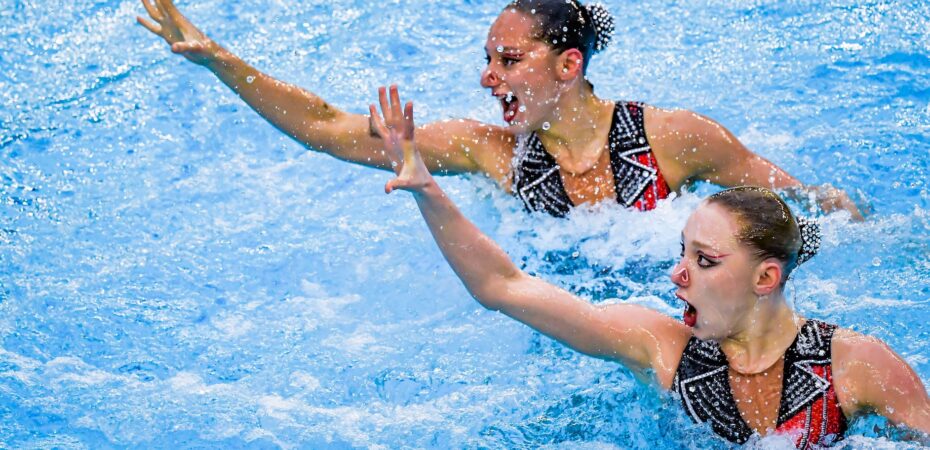
The second stop of the World Cup season got underway in Paris with a long and busy opening day, as four events – women’s and men’s technical solos, technical duet, and free team – set the tone for the competition.
The very first golds went to Vasilina Khandoshka (Neutral Athletes A) in the women’s technical solo and Guo Muye of the People’s Republic of China in the men’s event, while Neutral Athletes B dominated the afternoon events, taking top honors in both the technical duet and free team.
Women’s Technical Solo
The first event of the day got underway bright and early at 9:30, with 24 soloists taking to the pool to kick off the Paris World Cup.
It was Neutral Athlete A Vasilina Khandoshka who eventually came out on top with a score of 254.7184. The current world silver medalist delivered a commanding swim for gold, performing to music by Marilyn Manson. She fully committed to the character, pushing the limits of interpretation and earning the highest Artistic Impression score of the field.
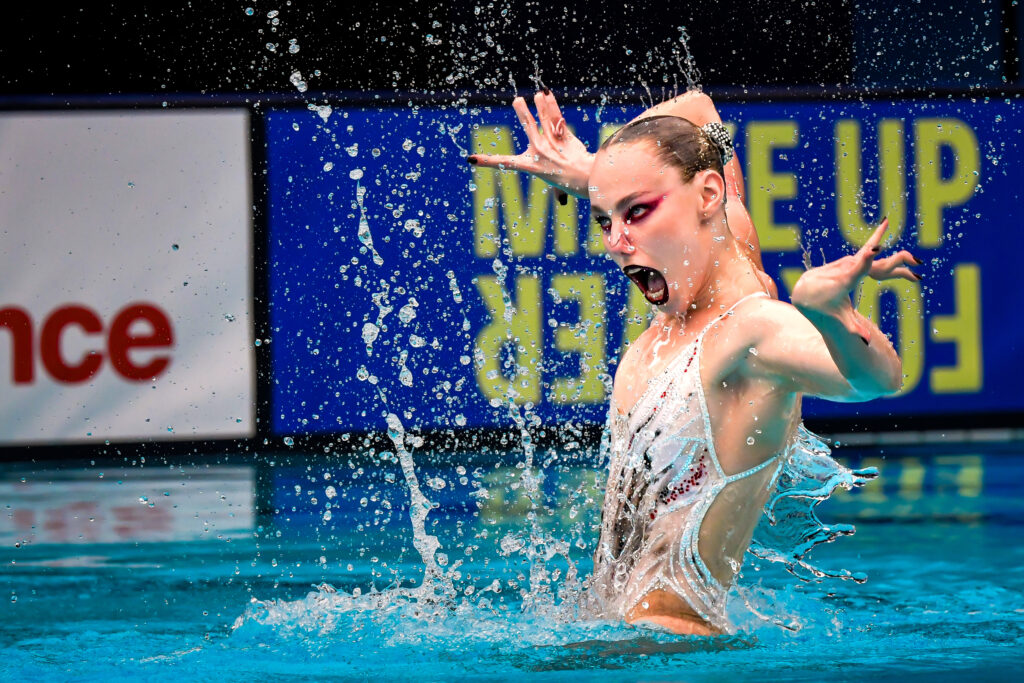
Silver went to Germany’s Klara Bleyer, who improved on her bronze from the Medellín World Cup earlier this season. There, a fluke mistake on an element had slightly reduced her Degree of Difficulty (DD), but this time there were no such issues. She scored 252.648 with her new routine set to Bach’s Cello Suite No.1 in G Major, continuing her work with Spanish Olympian Ona Carbonell on the choreography.
“I am happy about this medal,” Bleyer said. “I think I can still do better but it’s a good start to the season, it’s only March. Now, after Colombia, I can prove that I can swim clean and now it’s more about going into the details, and getting better with every competition.”
“Ona and I tried different music for this new solo and this was one of our favorites. It worked really well when doing improvisation and everything so we picked it. Also it’s Bach, it’s German, it’s classical music and a bit different. I really love this music and have a lot of fun swimming to it”
Bronze went to Neutral Athletes B Valeriia Plekhanova, making her senior debut. The reigning European Junior Champion brought the highest DD of the competition with 37.6, now the highest one seen since the reworking of the DD calculations following the Paris Olympics.
There were several other notable performances throughout the field.
Even though she swam fairly early on, 17-year-old Ismini Maria Karavasili of Greece spent much of the competition sitting on the live podium, delivering a high-energy routine themed around “Panic Attack.” It was a performance that stood out for its intensity and full-body commitment to the interpretation, ultimately placing her sixth overall. She is the reigning European Junior bronze medalist in the event.
16-year-old Selin Hurmeric of Türkiye opened the competition and made an impression in her first senior outing, finishing inside the top 10 in a deep field.
The reigning vice-World Youth Champion in solo presented a new routine themed around “Cats,” choreographed by Mayuko Fujiki, making strong use of her flexibility and detailed footwork. While she is still growing into her TREs and will continue to develop as the season progresses, the potential is clearly there.
“It is quite exciting and it’s a huge arena with very experienced athletes,” Humeric said. “It was a big achievement for me to be here, swim solo, and now to place in the top 10. [With this routine], I wanted to challenge myself with the artistic side a little bit, and I wanted to portray a character, that’s why I chose [Cats].”
Just behind her in 11th place was France’s Carla Pusta, also 16, marking a solid first senior performance as well. She swam to “Heart of Glass” by Yseult, continuing a strong showing from this new generation stepping up onto the senior stage.
Men’s Technical Solo
The afternoon session got underway with the men’s technical solo with nine athletes taking to the pool. This event featured a particularly strong field that included current or former World and European medalists, at both the senior and junior levels.
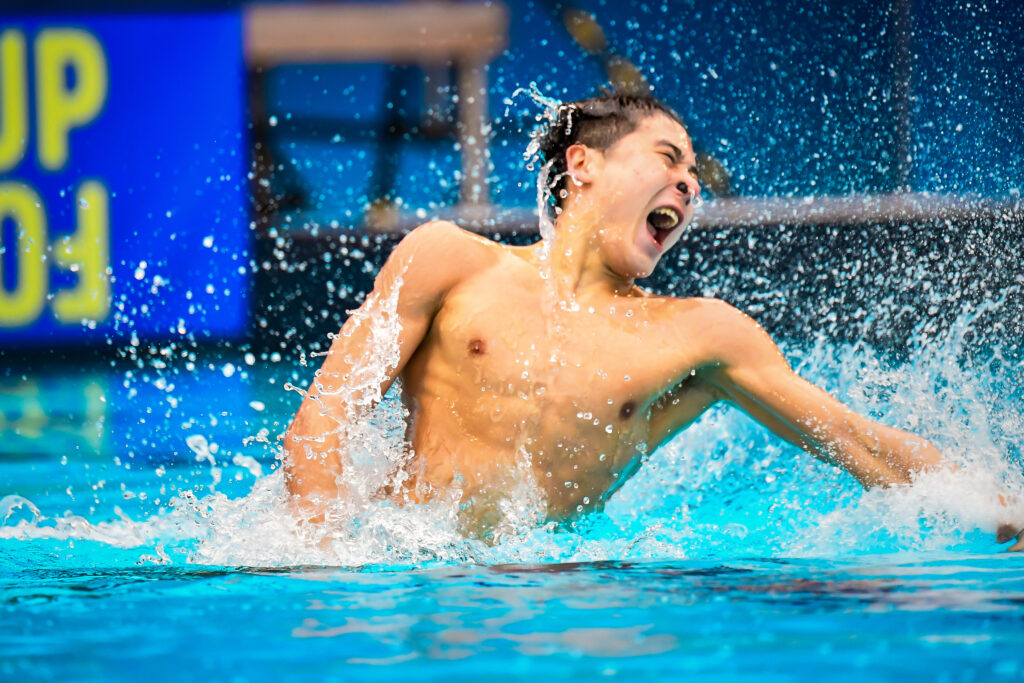
It was Guo Muye of the People’s Republic of China who led the way in both difficulty and execution. Delivering the highest DD of the event at 34.6 — now the highest seen since the revamp of the DD table like in the women’s event — he executed it successfully, setting himself apart from the field.
The reigning vice-World Junior Champion, who placed fourth at the Singapore World Championships, made his first appearance of the season with the same “The Witcher”-themed routine from last year, but with a noticeable step up in execution. Strong, precise, and confident throughout, he lived up to his status as the favorite to take gold with a score of 245.4900.
“My performance today was very good, so I am pleased with myself. I always want to do my best and go for gold.”
Silver went to Great Britain’s Ranjuo Tomblin, the reigning European Champion. After winning gold in Medellin, he returned here with a brand new routine, ultimately taking the second spot with 238.9359. Swimming to “Careless Whisper” by George Michael and working with Bill May on the choreography, he showed a different side to his swimming.
“It’s a new choreography by Bill May. I was very excited and lucky to be able to work with him, and to also show something different. I’ve always felt like I’ve had my music chosen for me, so this year I’ve decided, ‘No, I’m going to choose my own music, something that I can swim, something that I can feel too.’
I’ve always loved this song, it brings out a lot of emotions, and it’s well-known. We finished choreographing it at the end of January, so I couldn’t quite enter it for [the World Cup in Colombia], but we have been working on it since, so I’m very happy and glad it all came together here.”
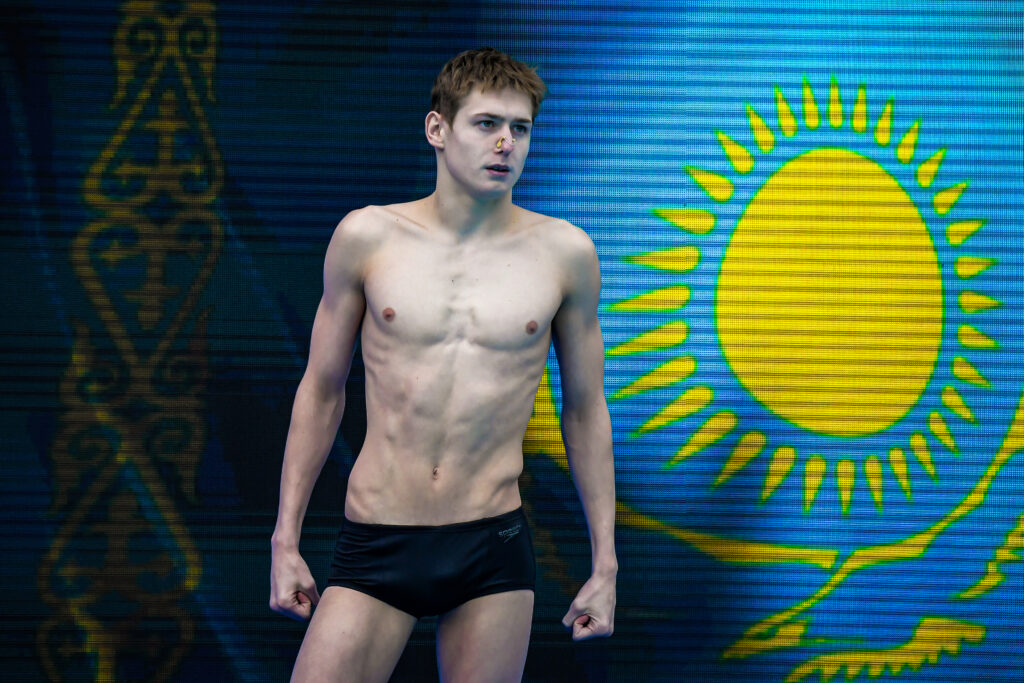
Bronze, as in Medellin, went to Kazakhstan’s Viktor Druzin with his “Fakir” routine, scoring 226.6050.
Just behind, his teammate Eduard Kim delivered one of his strongest performances to date in this event. With very secure TREs and a notably high Artistic Impression, he climbed to fourth place despite starting with one of the lower DDs. It wasn’t quite enough to challenge Druzin, who combined higher difficulty with stronger execution, but it marked a very clean and, as always, very expressive swim for Kim.
Italy’s Filippo Pelati, the reigning European silver medalist, debuted a new routine as well, set to the theme of “Freddie Mercury” for his first outing of the season. While the performance showed promise, a basemark on his free hybrid ultimately dropped him out of podium contention.
Technical Duet
The afternoon continued with the technical mixed duet, bringing together a deep field of 28 pairs.
Gold went to Neutral Athletes B’s Mayya Doroshko and Elizaveta Minaeva with a huge 299.8376. In their first season together, but both already highly experienced on the national team, they delivered when it counted. The pair had picked up two basemarks in Medellin but they had no such issues this time.
Swimming to “Rising Force” by Yngwie Malmsteen, their hard rock routine was fast-paced and sharply executed, earning them the top spot with a DD of 37.45, the third highest in the field.
Silver went, again, to NAB‘s second duet made of Kira Cherezova and Valentina Gerasimova, who scored 290.5550 with their “Fun Girls” routine on their international debut. Swimming fourth, they set the benchmark early and held onto the top position for most of the event, only overtaken by their teammates Doroshko and Minaeva.
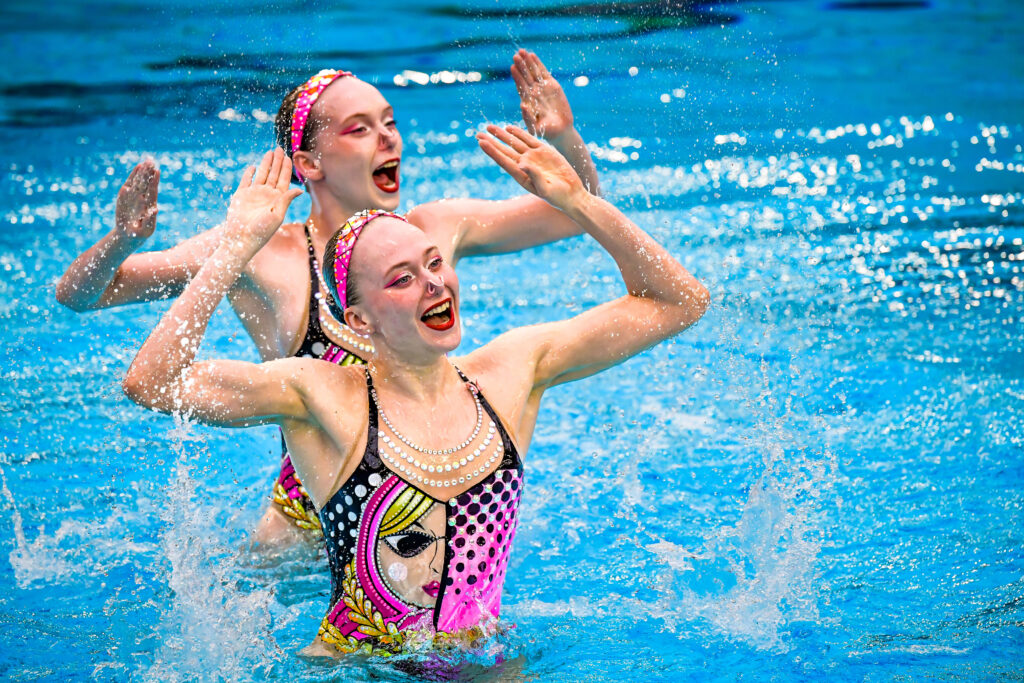
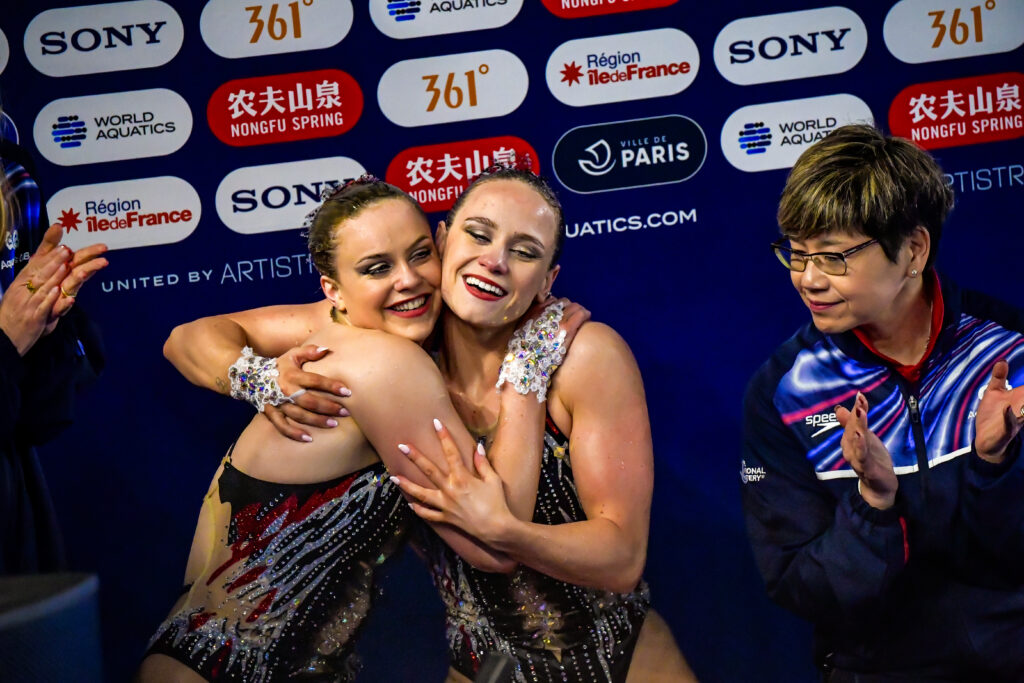
One of the main storylines of the event was obviously the return of Olympic silver medalists Kate Shortman and Isabelle Thorpe for Great Britain. While Thorpe has continued competing throughout last season in mixed duet, Shortman had taken a break, albeit still swimming and keeping in shape, but only returned to elite training a few months ago.
Now back in competition together for the first time in a year and a half, the pair presented a new choreography to “Dernière Danse” by Indila, as a nod to their final swim at the Paris Games.
It was a clean and composed performance, rewarded with bronze and a score of 287.8250. Closing with an acrobatic element at the very end of the routine added an extra layer of risk, and impact, to an already exciting return.
“It’s been really fun, and such a different journey to this competition compared to what we’ve done before,” Shortman said. “Even though the training is still very intense, it was nice to enjoy the swim and really take in the moment.”
“Yes, especially because the last swim we had together was such in a high-intensity, high-pressure situation,” Thorpe continued. “It was really nice to go out there, perform, and enjoy it a bit more fully.”
Just off the podium in fourth were the USA’s Anita Alvarez and Jaime Czarkowski, with a score of 280.8549. Swimming to “Dream On” by Aerosmith, they achieved the highest Artistic Impression score of the entire event and held onto a podium position for much of the competition, only dropping to fourth when the British pair swam second to last. There was some clear disappointment, but in such a competitive field and in only their second competition as a pair, it remains a standout result.
France followed in fifth with Laelys Alavez and Romane Lunel, also in their first season together in technical duet. After taking bronze in Medellin, they delivered another solid swim at home with their “Heart” routine, backed by a particularly loud and engaged crowd.
“It was a good step forward compared to Medellin,” Lunel said. “No basemark this time, we’re starting to really get used to the choreography, even though there’s still work to do. We’ve been training a lot together this year, really focusing on the duet, so we’re always together and this helps in the water. Everything feels easy, natural, we can say things to each other as they come. We know we’re progressing, and having the energy of the crowd really lifts us. It means a lot.”
On their theme, Alavez explained:
“We felt it was quite original for a technical duet, which usually has more upbeat, dynamic music. This is almost more like a free duet theme, but that originality really carries us, especially in the presentation.”
Lunel added:
“We actually built the choreography first without the music, and then the musician we work with added sound to match each movement. It was a very different approach, and it helped us find movements that really suited us and highlighted our strengths. It was really interesting to put it all together.”
Free Team
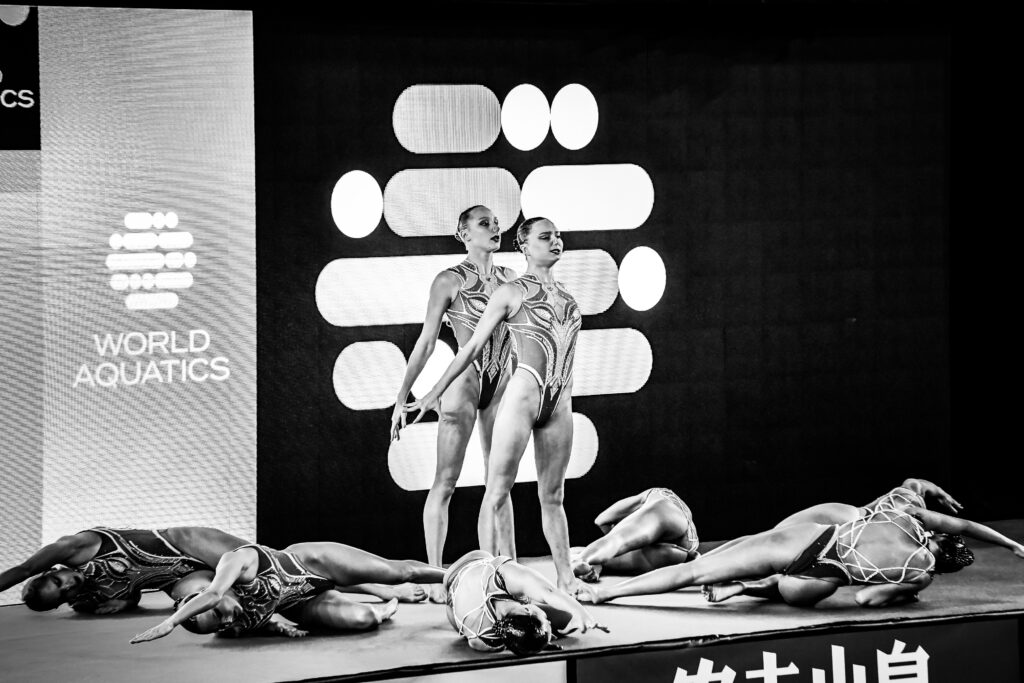
The long day of competition concluded with the free team event, with five nations entered, bringing the first day in Paris to a close.
It was Neutral Athletes B who set the tone early and decisively. First to swim, they immediately set the standard very high, delivering a routine that had already been highly anticipated, as it marked their first appearance in this event since the Tokyo Olympics. Even in training, there were signs this would be something special, and they fully delivered here — all the more impressive given the quick turnaround for Mayya Doroshko and Elizaveta Minaeva, who were back in the water shortly after competing in the technical duet.
With the highest DD of the event at 73.75, they presented “Online – not alone,” a program built around an inner dialogue following a girl navigating doubt and isolation, before gradually finding clarity, support, and inner strength through her chat with AI.
Choreographed by Olympic Champion Marina Goliadkina, the routine left little to critique, as it was a confident, complete performance that marked a very strong return to the event. They took gold with 260.6329, a score that, in the context of the new factoring, will still take some getting used to, especially with technical duet totals now surpassing free team scores by that much.
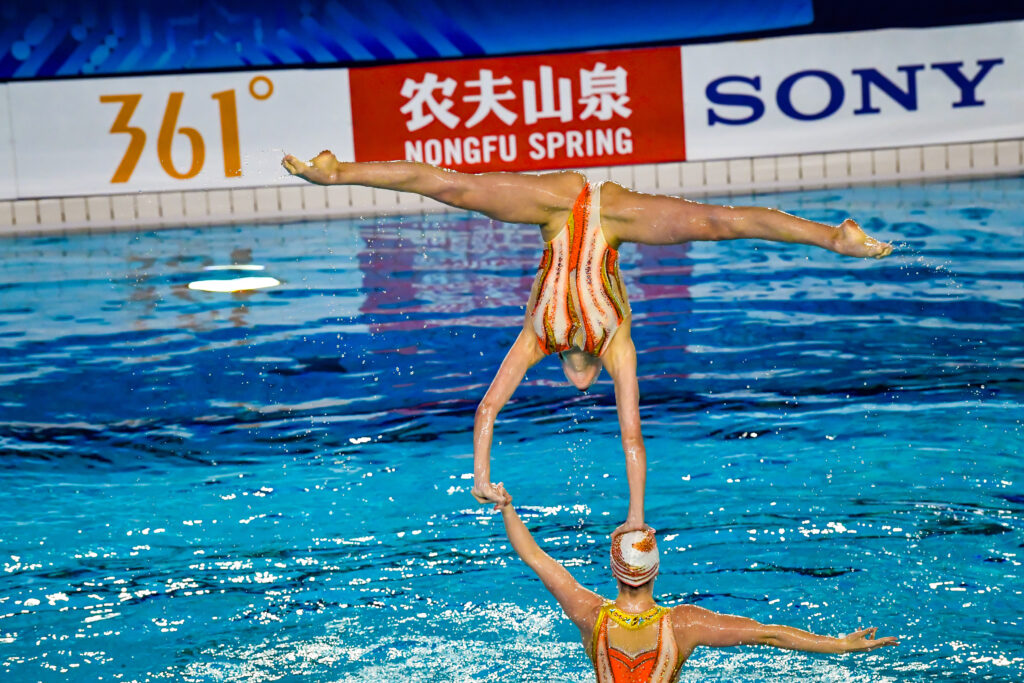
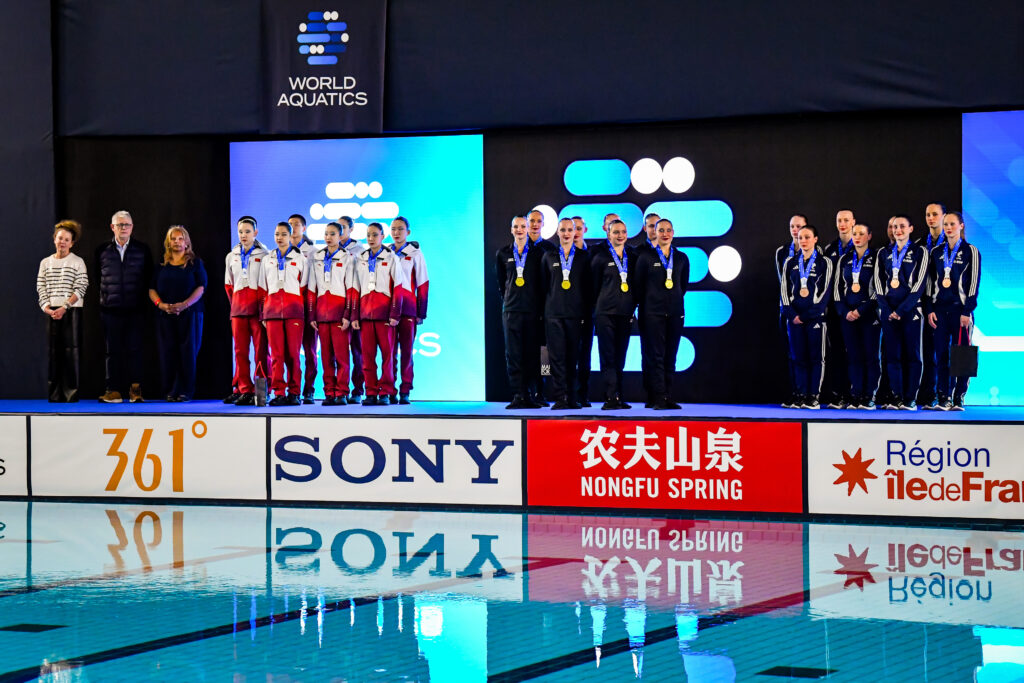
Silver went to the People’s Republic of China, fielding their “B” team, with a clean, basemark-free swim scoring 238.3467. Their “High Mountains and Flowing Water” routine, which notably included two men, has only been in development for around two months, making this a solid and composed outing with clear room to grow for these athletes..
France claimed bronze in somewhat unexpected fashion. Their “Illusions” routine marked a return to the event after sitting it out last season, and while they incurred a clear basemark on the final hybrid, it ultimately did not cost them a place on the podium.
A key highlight was Clara Pusta, who, after competing in the solo earlier in the day, stepped into the role of acrobatic feature swimmer and is already settling into it impressively. The music felt familiar in style for the French team, but also very much in line with what suits them best.
“We came up with a lot of ideas very quickly [for this routine],” said team captain Angéline Bertinelli. “It’s not always easy to combine artistic expression with technical difficulty, but I think we’ve put together a beautiful routine. It’s great to be back in competition, especially in Paris with all the noise and the crowd. This is our first free swim since the Olympics. We got off to a good start, and we all wanted to show that we were here. We handled it pretty well, it was just the last element that cost us a basemark. It’s a start; we can only get better.”
European silver medalists Italy, the final team to swim and a strong contender for the podium, had an outing (with three basemarks) they will likely want to move past quickly, which ultimately allowed France to hold onto third place.
ARTICLE BY CHRISTINA MARMET
Cover photo: Dimitris Mantzouranis / @shootinlights
If you’ve enjoyed our coverage, please consider donating to Inside Synchro! Any amount helps us run the site and travel costs to cover meets during the season.