
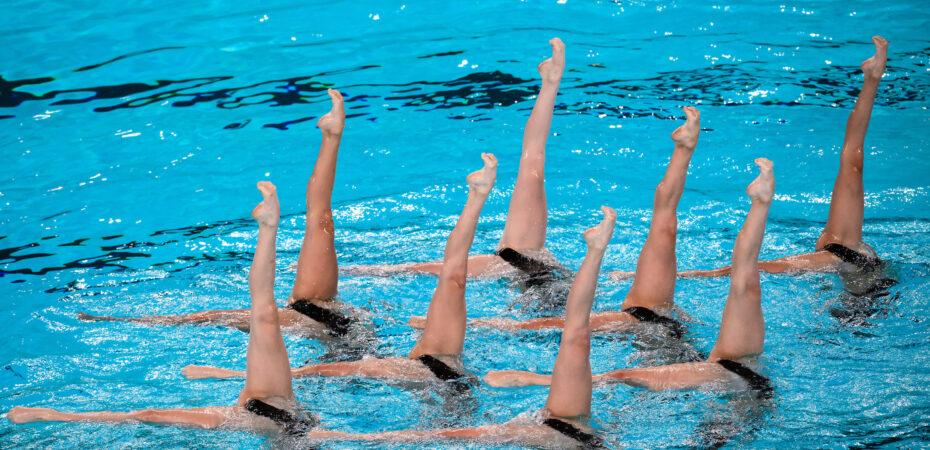
The drafts of the new artistic swimming rules came out a few weeks ago, giving us our first look at what will change heading into the 2027 season and the start of the qualification process for the LA28 Olympic Games.
At the top of the list are, of course, the new Technical Required Elements (TREs), but there is plenty more to unpack that is just as important. The latest updates also introduce new Youth and U12 Figures, changes to routine times and Elements, a re-calibration of several movements and families in the difficulty table, and some general housekeeping.
Before diving into it, please bear in mind that all these rules are still in draft form and remain pending approval at the World Aquatics Bureau meeting. Some details may therefore still change before the final regulations are published.
General Updates
Most free routines will be shorter and contain fewer Elements, while some events will also see new additions, such as the Choreography Hybrid, as well as some adjustments to the requirements. At the youth level, the Free Combination will also be replaced by the Acrobatic Team event.
One smaller change worth noting is that only two Synchronization Technical Controllers will officiate in the applicable events, down from three previously.
Times of Free Routines
-
Junior / Senior
At the junior and senior levels, technical routines don’t see any changes to their set times. The free mixed duet and acrobatic team routines are also unchanged.
The events below have however been shortened:
– Free Solo: 2:15 mins → 2:10 mins
– Free Duet: 2:45 mins → 2:25 mins
– Free Team: 3:30 mins → 3:10 mins
-
U12 / Youth
Both U12 and Youth categories will now share the same set times and number of Elements for routines.
The events below have seen their time change:
– Free Duet: 2:30 mins → 2:10 mins
– Free Team: 3:00 mins → 2:50 mins
– Free Combination (U12 only): 3:00 mins → 2:45 mins
The length of the free solo and free mixed duet is the same.
Number of Elements per Routines
Going hand in hand with the shortening of some routines, the number of Elements has also been modified when necessary. Some new Elements or additional requirements have also been added on select routines.
-
Junior/Senior
At the junior and senior levels, the number of Elements for the technical solo, technical duet and acrobatic team routines remain the same.
The events below have been changed:
– Free Solo: 6 Elements → 5 Elements.
A soloist will now have to do 4 Hybrids (instead of 6) and 1 Choreography Hybrid.
– Free Duet: 8 Elements → 6 Elements.
The athletes will have to show 4 Hybrids and 2 Pair Acrobatics.
– Free Mixed Duet: It’s still 7 Elements, but with one less Hybrid.
But now it’s 3 Hybrids, 1 Choreography Hybrid, and 3 Pair Acrobatics. The routine must also still include a minimum of 4 SuCons.
– Technical Team: It’s still 8 Elements, but with one less hybrid and one more acro.
So, now it’s 5 TREs, 1 Hybrid which must include a cadence action, and 2 Acrobatics.
– Free Team: 9 Elements → 8 Elements.
A team will have to show 5 Hybrids (instead of 6), and still 3 Acrobatics.
In the Technical Mixed Duet, the only change comes in the wording regarding the Surface Connections (“SuCon”). The word “minimum” was simply added, like in the free event, so the routine must include a minimum of three declared SuCons.
-
U12/Youth
These are the age groups that probably see the most changes. Most notably, the Acrobatic Team event will replace the Free Combination in the Youth age group. The Free Combination will only be done in the U12 category.
As mentioned earlier, the routine requirements are now common for both age groups.
– Free Solo: 5 Elements → 4 Elements.
Although the set routine time hasn’t changed, one Hybrid was removed.
– Free Duet: 6 Elements → 5 Elements.
The athletes have to show 4 Hybrids and 1 Pair Acrobatic.
– Free Mixed Duet: 5 Elements → 6 Elements.
This is the sole event that sees one Element added rather than removed. It will still feature 3 Hybrid and 2 Pair Acrobatics, but now there’s also 1 Choreography Hybrid. A minimum of 3 declared SuCon are still required as well.
– Free Team: 8 Elements → 7 Elements.
A team will have to show 4 Hybrids (instead of 5), and still 3 Acrobatics.
– Acrobatic Team (Youth only): 5 Elements in a 2:30 mins routine.
Athletes will have to show 5 Acrobatics. Acrobatics from groups A, B, and P are mandatory, but group C is optional. As with the juniors/seniors, there’s a maximum of 2 from each group, and teams must not repeat the same acrobatics.
– Free Combination (U12 only): 9 Elements → 7 Elements.
Routines will show 3 Team Acrobatics (instead of 4), 1 Solo Hybrid, 1 Duet Hybrid, 1 Team Hybrid (instead of 2) and 1 Team Choreography Hybrid. Both team hybrids have to be executed by a minimum of 4 athletes.
These two age groups also continue to have Degree of Difficulty (DD) safety limits for all acrobatic elements.
Introduction of Choreography Hybrids
One of the more intriguing additions to some free routines is the Choreography Hybrid, which comes with a fixed DD value of 1.0. While it is not entirely new, having already been part of the Youth and U12 Free Combination routines in recent years without a designated DD value, it is now being introduced across all age groups and into more events, bringing it into greater focus.
According to World Aquatics, this Choreography Hybrid is designed to put the focus firmly on “artistic movement and personal expression,” and should reflect the athlete’s “style and musicality.” The idea is to give athletes and coaches an opportunity to move beyond simply the difficulty table and create something that is both genuinely their own and visually compelling.
Judges will be looking for “thought, intention, creativity and effort,” with the expectation that athletes and coaches make a “genuine artistic contribution” through the hybrid. As was said during the presentation, “doing the bare minimum will receive the bare minimum score.”
There is, however, an interesting question around how this will work in practice. Beyond the requirement for at least five movements for it to count as a hybrid rather than a transition, there do not appear to be any other specific criteria defining the Choreography Hybrid.
The concept is deliberately open-ended, but with a fixed DD of just 1.0, there seems to be little reason at this point to spend significant time and energy underwater on something that cannot generate additional difficulty.
That said, the full picture is not yet clear, as the factors for this new Choreography Hybrid have not been released. How it is ultimately rewarded could make all the difference between a genuine opportunity for creative expression and another box to check on the Coach Card, albeit a much more artistic one.
A potential, soon-to-be worrisome problem?
With all of this, are we heading towards even longer Hybrids?
Overall, routines are indeed slightly shorter and with fewer Elements. In theory, that should also create more room for distinctive choreography and artistic transitions.
However, one thing that immediately stands out is that there are still no apnea time limits. With fewer Elements available to accommodate the DD, there is a real possibility that we could end up with even longer underwater times than in recent seasons, which were already quite concerning.
Take the free solo. The routine is only 5 seconds shorter, and it now must include just 4 Hybrids and 1 Choreography Hybrid. On paper, that sounds good: more or less the same amount of time as before, but with less to do. Great.
Except those 4 Hybrids now have to carry the bulk of the difficulty, instead of 6 previously. And with no limit on how long athletes can stay underwater, it is not difficult to see where this could go.
New Technical Required Elements
Finally, some new Technical Required Elements! These were initially expected to be updated after the Singapore World Championships, but following requests to keep changes to a minimum for one more season, we are only now getting this new set heading into 2027.
We won’t go through every TRE here, as the full list is available online, along with YouTube videos showing the elements themselves. Instead, let’s look at some of the broader ideas behind the changes and a few things that stand out.
World Aquatics has taken into account feedback from the community as well as several groups, including the Coaches Committee, the Technical Artistic Swimming Committee, and last but not least, the Olympic Committee.
One of the main requests, and therefore goals, was to make the TREs more aesthetic, creative and interesting to watch, particularly in the Olympic routines.
Across the board, the new TREs include plenty of changes in direction and height, making them more dynamic and also requiring athletes to work both sides of their bodies.
Moreover, the new TREs come with slightly higher DDs overall, reinforcing their importance and giving them greater weight in technical routines.
Some TREs from the previous cycle are sticking around, including, for example, the Barracuda Spin 720 (1A) / 360 (1B) in the solo, and the Thrust Bent Knee Twirl Spin 360 (1A) / 180 (1B) in the duet.
Others bring something new to the table. The new team’s 5A/5B, for example, introduce a required pattern change for the first time. Within the element, all athletes must perform a pattern change with obvious travel, facing the same direction, although they do not all have to travel in the same direction.
Another notable change is that men’s solo now has its own set of TREs, which is a very welcome development.
These TREs should be in place for the 2027, 2028 and 2029 seasons. What remains to be seen is when the next revision will come: after the 2029 World Championships in Beijing, as might be expected if we return to the “usual” cycle, or in 2030 to maintain a four-year cycle.
In any case, for now, athletes and coaches have a new set of requirements to get to grips with as the sport enters the Olympic qualification period.
New Figures
As with the TREs, we won’t go through the new Youth and U12 Figures individually, as everything is available online once again.
Here, the broader goal was to establish a smoother, more logical progression from U12 through Youth and into Junior and Senior levels, with skills building on one another along the way.
For U12, the aim was to increase the difficulty of the figures to better match the level of difficulty now seen in routines, while also bridging the gap between U12 and Youth Figures. New static positions, such as Knights, and key transitions that have become increasingly important under the current scoring system are being introduced, with an emphasis on developing proper technique from an early age.
The Youth Figures continue this progression, building on the skills, positions and transitions introduced in U12. Another change is that all athletes in the Youth category should now perform the same two figures.
Changes to the Hybrid Difficulty Table
Updates to the difficulty table include new additions to the Airborne Weight family, as well as re-valuing of many hybrid elements.
Notably, there has also been a change to the number of allowed declarations, with the new limit being 5 declarations per family per hybrid, with a limit of 2x per technique (previously, the limit was 3x per technique).
Additionally, factoring in hybrids is now limited to “10 code declarations, 5 at 0.5 and 5 at 0.3.” Yes, that means no more Chaos Hybrid.
In the Thrust (T) family, level 4, 6, 7, and 8 elements are now worth between 0.05 and 0.10 more than last season. Additionally, what was previously a T9a (thrust to height of 8.5 or higher followed by spin 1080° or more) is now a T10, valued at 2.30.
Spins (S) have increased in DD value across all levels, with the highest-level S10 now worth 4.90 compared to last season’s 3.95. The highest-DD spin, however, is a two-direction combined spin 2160° (SCD6), which is worth 5.80—just 0.15 less than a RU10 from the twists (R) family, in which all DD values have stayed the same.
The upper levels in the Airborne Weight (A) family have undergone some interesting changes, including the addition of airborne weight levels 9 and 10. Essentially, the levels in this family have been revised to make room for new declarations to better support developing athletes.
An A10 this season is the same as last season’s A8, both in regards to DD value and the definition of the element. The same goes for the new A9, which is the same as last season’s A7, as well as the new A8, which is the same as last season’s A6.
This year’s A7 and A6, however, are brand-new additions to the DD table. This season, A7s are worth 0.90 and defined as “3 seconds of up and down movements with two legs.” The new A6 is defined as “3 seconds or up and down movements with one leg or a combination of one or two legs,” and is valued at 0.80.
In response to an abundance of back injuries among athletes this past season and overuse of these moves, elements in the Flexibility (F) family have had their DD values reduced significantly. An F10, for example, used to be worth 1.3 but is now only 1.0.
Similarly, F9s have been reduced to 0.75, F8s to 0.65, and F7s—which have also had their definition adjusted to require a clear stop in vertical position—to 0.50. These reductions in DD extend all the way down to Flexibility level 4, now valued at 0.35, but the values for levels basic (0.05) through 3 (0.30) remain unchanged.
There have also been some additions to the Flexibility family’s lower levels, such as the F3d (fishtail to knight or knight to fishtail, bending moving leg through vertical line) and F4e (fishtail to knight or knight to fishtail, moving leg horizontally across the surface).
Finally, in the Connections (C) family, all elements and their corresponding DD values remain the same.
All documents are available on World Aquatics, once again pending approval by the Bureau.
The recording of the TREs and Figures Presentation, as well as the corresponding Powerpoint, are also available here.
ARTICLE BY CHRISTINA MARMET & MARIKIT FLORES
Cover photo: Andrea Staccioli / Deepbluemedia / Insidefoto
If you’ve enjoyed our coverage, please consider donating to Inside Synchro! Any amount helps us run the site and travel costs to cover meets during the season.