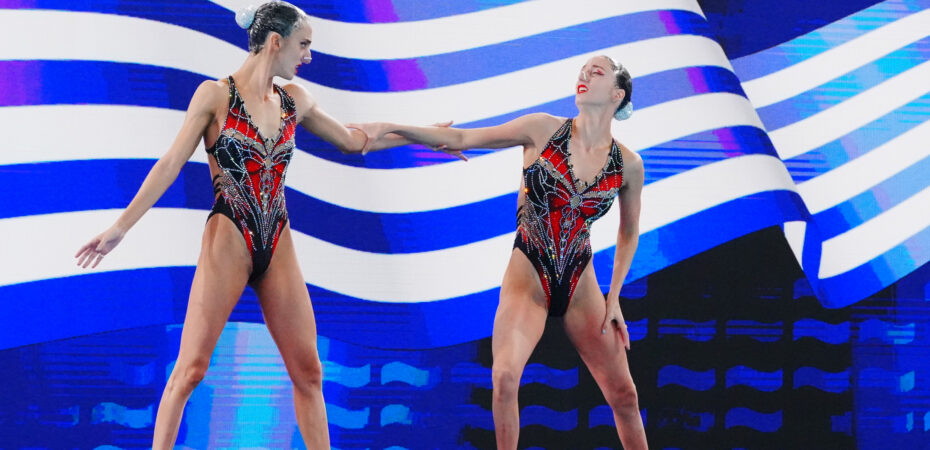
After more than a decade representing Austria on the artistic swimming international stage, Anna-Maria, Eirini and Vasiliki Alexandri made an emotional return to their home country in 2026, competing under the Greek flag for the first time in 14 years.
The move marked a new chapter for the 29-year-olds who built an impressive career in Austria, earning multiple World and European medals, competing at three Olympic Games, and establishing themselves among the world’s leading artistic swimmers.
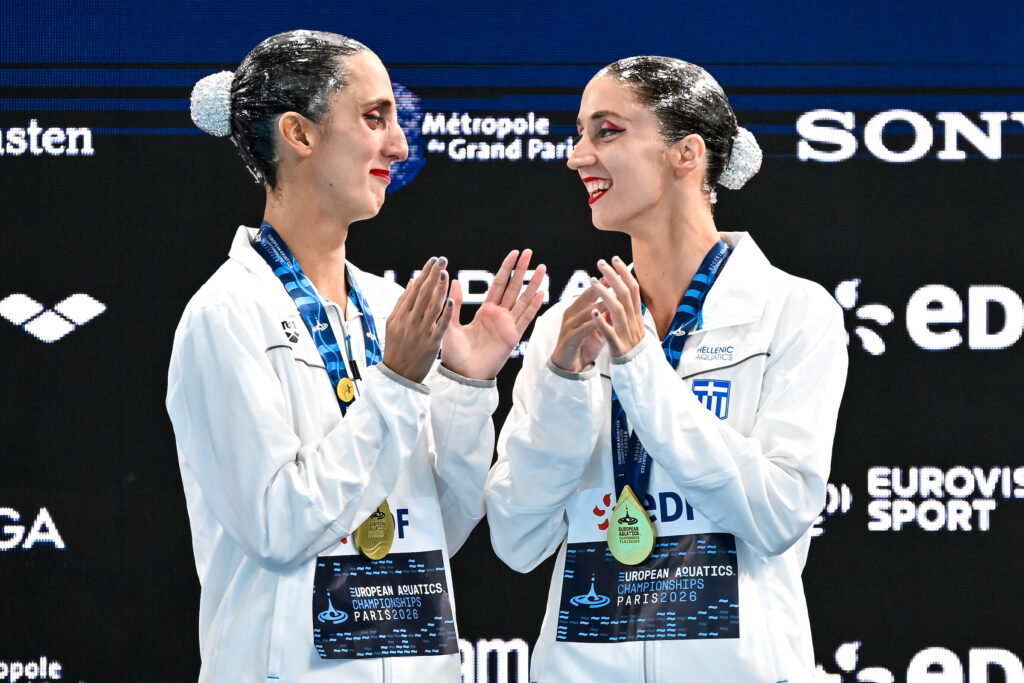
This summer, their first outing in white and blue was a memorable and meaningful one, as they claimed two gold medals in duet at the European Championships and heard the Greek national anthem reverberate in the Paris Olympic Aquatic Centre.
The road to this new beginning, however, was not without its challenges. Following the 2024 Games, the triplet sisters found themselves alone after longtime coach Albena Mladenova retired from international coaching. After several months navigating their preparation independently, they eventually joined forces with Japanese coach Takako Nakajima, with whom they prepared for the 2025 season, where they added three more golds to their medal record.
When that collaboration came to an end after the Singapore World Championships, the Alexandris were once again left to train on their own in Austria, relying on each other for both correction and motivation. It was then that the opportunity to return to Greece presented itself, one they had hardly dared to imagine could become reality.
Now settled into their new lives in Athens, Anna-Maria, Eirini and Vasiliki reflect on their decision to return to their homeland, what it means to represent Greece after so many years away, and their hopes for this new chapter in their careers.
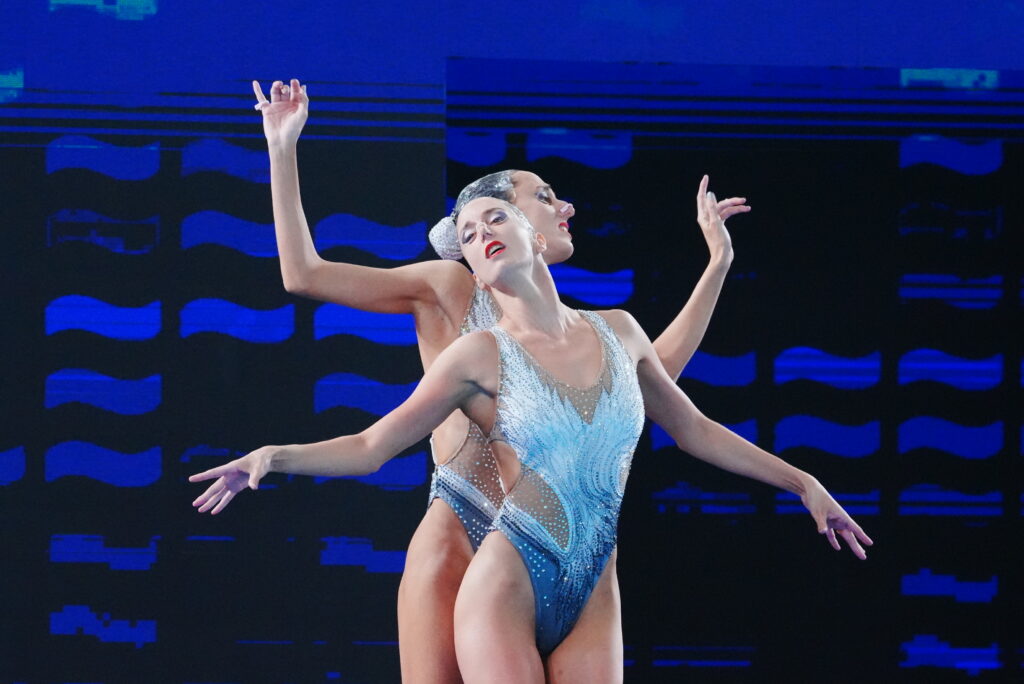
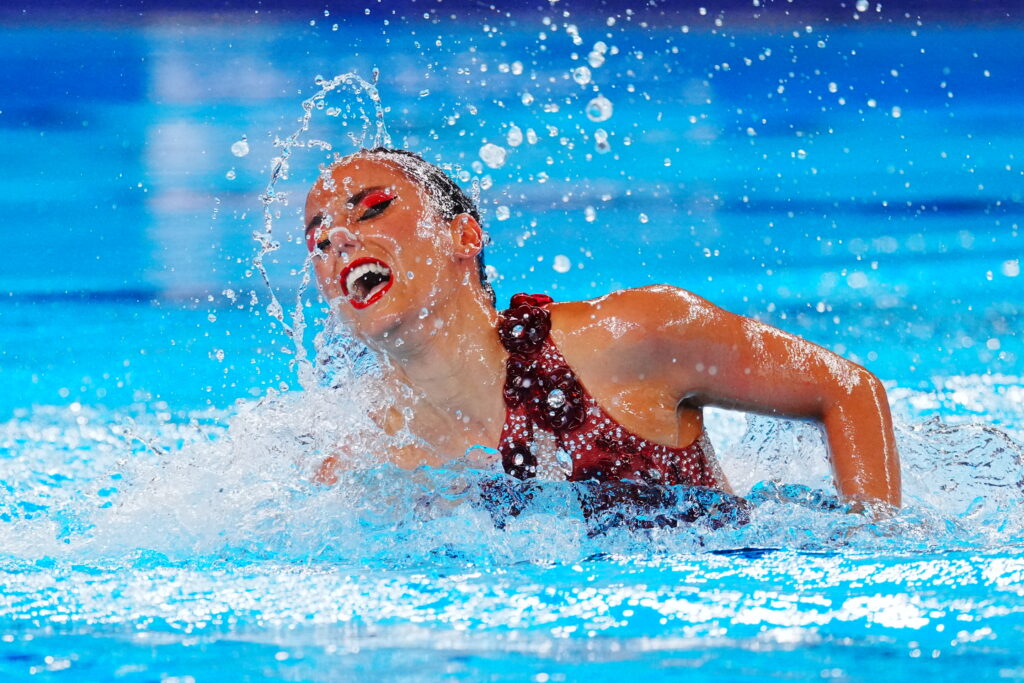
Inside Synchro: You’ve been back living in Greece for nine months now. How does it feel?
Eirini: Very special. On one side, it feels like we never really left, but on the other, it feels very new. So, it’s familiar, but different! We haven’t really realized yet that we are permanently in Greece. When we lived in Austria, we often did training camps abroad, so it almost feels like it’s another one. But we will soon realize that we really live here.
Still, sometimes, we don’t know where we are. For example, I wake up, and I am like, “Where am I?” Or even at the competition, at the European Championships, the announcer said, “Start number 11, Greece.” And it didn’t feel real that it was us. It’s very special. We cannot find the word to describe it. It’s amazing what happened; we cannot believe it.
IS: Tell us more about how your return to Greece came about.
Anna-Maria: We had been living in Austria for 14 years. It was a lovely chapter, but in the last few years, we started to say that we would like to return to Greece. We hadn’t defined anything, it was just a general feeling. We knew we always wanted to come back, we just didn’t really know when.
Eirini: And then the request came from Greece. For us, it was a big surprise and something that we didn’t expect, but yes, we really wanted it in our hearts. Everything happened very, very fast. Maybe that’s why we haven’t realized it yet…
We really have to thank the president of the Hellenic Olympic Committee, Mr. Isidoros Kouvelos, and the president of the Greek Swimming Federation, Mr. Kyriakos Giannopoulos. We immediately felt secure, appreciated and supported. They were telling us, “We really want you, we appreciate you, we believe in you.” It was an amazing feeling. Deep down, we had the feeling that it only could be yes. But of course, we had to think about everything.
Anna-Maria: Yes, because it was again a life-changing decision. We had done this 14 years ago, when we moved from Greece to Austria, which was also a very huge step. But we were 14 years old then, and it was not the same.
Now, we had built our lives in Austria, so we had to think about every aspect, both in and outside of sports, and all that it would imply. Even though deep down, we wanted to return to Greece, it still was not an easy decision and move.
IS: Could you explain why, 14 years ago, you decided to leave Greece in the first place?
Eirini: There were issues with the lack of meritocracy with the federation at the time. We were Greek Champions for five years, we won gold medals in solo and duet at the COMEN Cup in 2011. But still, we quickly realized we could not chase our dreams here.
So, we had three options. Either we would just accept it and continue under these conditions, we would stop synchronized swimming, or we would go abroad. Those were the options that our mother gave us, and also the reality. We didn’t want to stop, and we couldn’t continue like this, so we decided to move.
We never say never after this. We feel like we have lived a very full life so far. We are really thankful for everything, and because we were able to continue our passion.
Anna-Maria: To return to Greece now, with a very supportive federation, has been amazing. Sports in the country are also very important, we really feel this national pride as a sportsperson. When we spoke to both presidents and then when we came back, the whole country embraced us and supported us.
IS: How was the transition back to Greece and to a new training environment?
Vasiliki: The transition wasn’t so easy, even though yes, we were coming back home. But first, we are actually from Volos, so we had to get used to living in Athens, which is a huge city. And then of course, we also had a new apartment, new training schedule, new coaches, new everything really. So yes, we needed some time to adapt, but I think we managed well.
Anna-Maria: The months before were actually the most difficult for us. We were alone again with no coach after Singapore until we moved here in March. But, we still had to train. We also had to think about this life-changing decision, and we were finishing university…
Eirini: It was a lot at once, and in a short time. At the beginning, we were at a hotel here. At the same time, we had to train of course. Then, we had to move all our lives into our new apartment. Like, 210 boxes! We still have some stuff to unpack, but it’s much better now, and our mother has helped us a lot. We really only just finished the move recently. We were back in Austria in September to finish everything and give our apartment back.
Anna-Maria: As for training, we have very good conditions here. In Austria, we trained in only two or three lanes, and here, we have a whole pool for us. Also, obviously coaches (laughs). We didn’t have to work alone anymore.
While we waited for the paperwork [to go through], we focused on training and getting to know each other with the coaches (editor’s note: at the time Meng Chen, Ceci Jimenez and Zoi Voutiraki). They also had to plan everything for us, because our arrival was also very sudden for them. We needed a new choreography for the free duet too, because we hadn’t done one since the Olympic Games. Vaso had two new solo choreographies as well. It was a huge project, and we all had to be really fast and adapt.
Eirini: And in the middle of this big change, we had hard times in our personal life too. We lost our uncle one month before the European Championships. And, two weeks after we arrived in Greece, we got a call telling us that Walter [Bär, Sports Director at the Austrian Swimming Federation] had passed away. It was very shocking to us, we were with him still only a few weeks before.
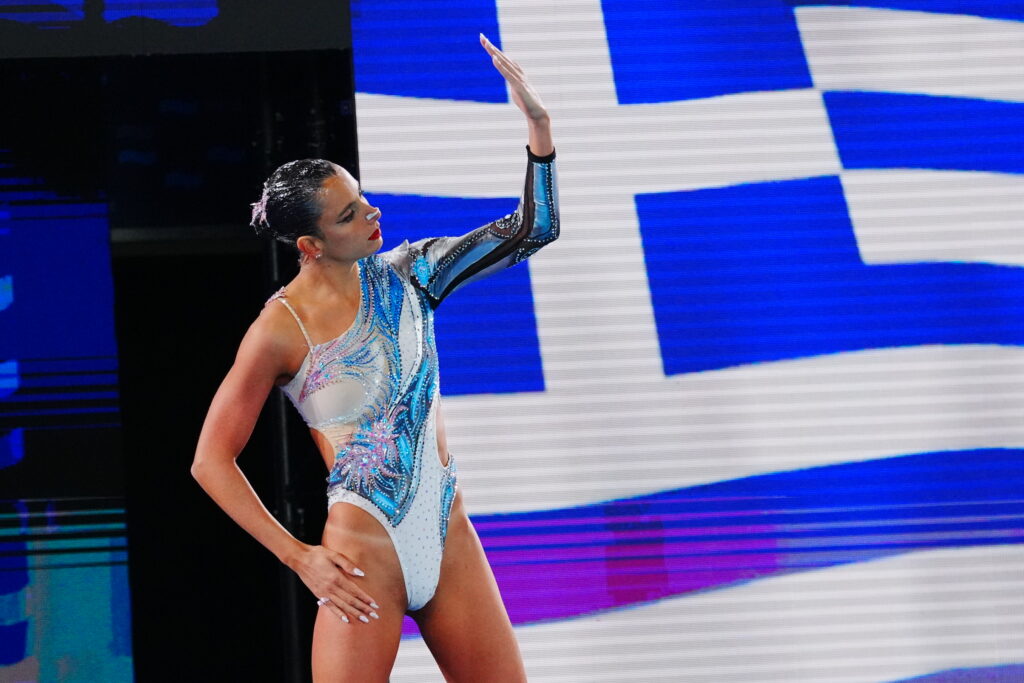
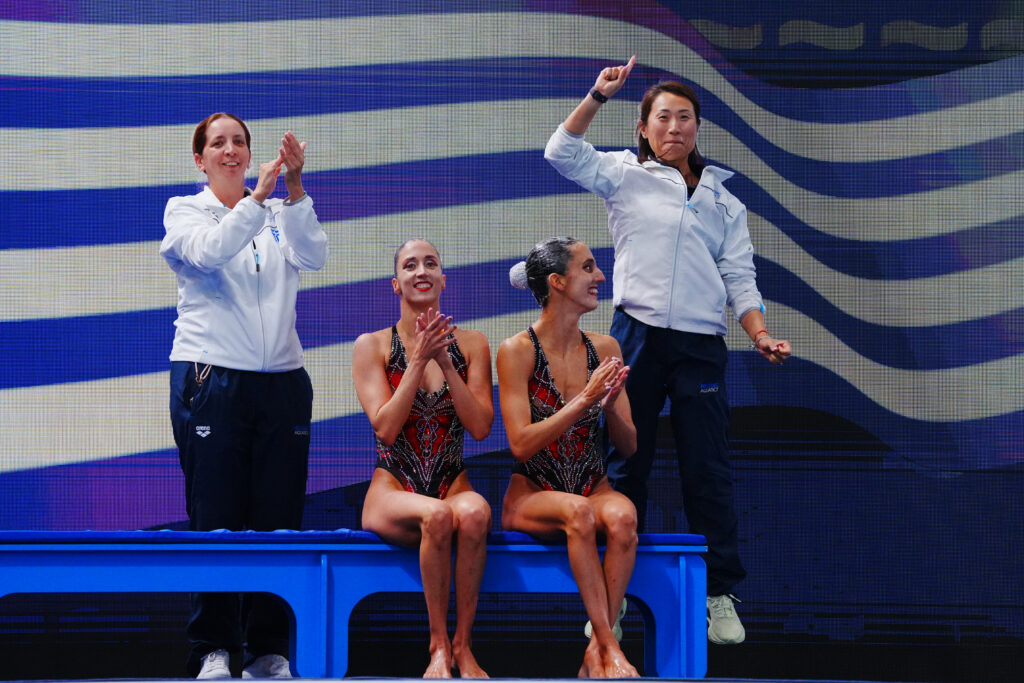
IS: The European Championships in Paris were your first competition for Greece and after a year away. How did you feel going into it?
Vasiliki: For me, it was not easy. I had two new choreographies and I was of course very excited. But a month and a half or so before the European Championships, I got injured, and then the week before, I got really sick. I had a very high fever and couldn’t train. It was a big challenge to handle everything.
With all of that, I was a little bit stressed, and also because I really wanted to do good. Honestly, I’m a little sad that I couldn’t enjoy my first competition with the Greek national team as much, and also after all this time away.
What pushed me a lot and motivated me was when Mr. Kouvelos came to watch us at the competition, and even at our training. It was a great feeling to feel so supported, despite a lot of stress for me. I did everything I could in Paris, so I am still satisfied with myself. I see this year more as a transition year for me; it was a lot of adaptation.
Eirini: For me, it really didn’t feel like we were away from competitions for one year. It felt like we had seen everyone only a few months before at a World Cup or something. We had the normal amount of stress, and we were just really excited for this competition. It was also such a unique feeling to wear the blue and white colors on our cap and our uniform, to see “Greece” written on them.
Anna-Maria: Yes, actually I think I was at my calmest, ever. When we discussed this moment at home, many months before, I was a bit concerned that maybe we were going to be more stressed than usual, because we didn’t compete for one year. But really, I have never been so calm. It all felt familiar and comfortable.
Eirini: Maybe the pressure will get higher in the next two years, with the Olympics getting closer, but since the Paris Olympics, I think we have mostly enjoyed the competitions. In general, we are calmer and more aware of what we have to do, and only focusing on this so we can enjoy the whole experience more.
IS: How did it feel hearing the Greek national anthem play for you?
Eirini: It was very emotional. Last time that we heard the anthem, it was at the COMEN Cup 2011. So to hear it again, we had goosebumps. It’s one of the best moments in our career, and really an unforgettable feeling. It was also very special because our mom was there. She couldn’t come to Singapore or Funchal [for the European Championships] last year, so to have her in Paris was really emotional.
Anna-Maria: Also, the first time we heard the Austrian national anthem play for us was in Baku [for the European Games] in 2015, in the technical duet with a Swan Lake routine. That was also the first time we won a medal for Austria. And now, this was the first time that we won a medal for Greece since our return, also with a Swan Lake routine. This music has a very special place in our heart.
IS: What are your plans for this upcoming season?
Vasiliki: Of course, the highlight for all of us is the World Championships. My goal is to show my best and win a medal in solo, of course. I want to fight and to chase the top, actually. Then also, do some World Cups, and maybe the European Games, but it was only duets and teams last time, so we will see. (editor’s note: the event programme for the European Games hasn’t been released yet.)
Anna-Maria: For us in duet, we will probably do some World Cups as well, the European Games and yes, the World Championships. Of course, we always want to improve and develop ourselves even more. We want to like what we see. So the main goals are the performance, and to win the gold in the World Cups, the European Games and at the World Championships, and therefore qualify for the Olympic Games. And in the long term, the goal is the Olympic gold medal and we will fight for it.
Eirini: We feel that we can give more, that our body still has a lot of power. We feel very fresh and energized, so I think we can really push ourselves. To know that people believe in us so much gives us a lot of strength too. Of course, we would like to hear the national anthem both in the World Championships and the Olympic Games. We are going to give our best because we feel the support.
IS: After everything you’ve been through over the past few years, what made you want to keep going and give yourselves another chance at the Olympic Games?
Anna-Maria: Actually, right after the Paris Olympics, we gave an interview where we said that maybe we were going to stop. It was soon after and the emotions were really high. Then we took some time away from the pool, we went on holidays, we went home to Greece. We also asked ourselves difficult questions, like, why are we still doing this? And, we remembered our passion. It is the love for the sport that won, actually. We really believe that we can do it, and we will fight until the end.
At the time of the interview, the triplets had yet to discuss their plans for the upcoming season in detail with their coaches and the Greek Swimming Federation. This included both their exact competition schedule and the possibility of joining the Greek team routines. Since then, the national team’s coaching staff has also undergone a change, with Hiea-Yoon Kang replacing Meng Chen as head coach.
ARTICLE BY CHRISTINA MARMET
Cover photo: Aniko Kovacs/European Aquatics
If you’ve enjoyed our coverage, please consider donating to Inside Synchro! Any amount helps us run the site and travel costs to cover meets during the season.