
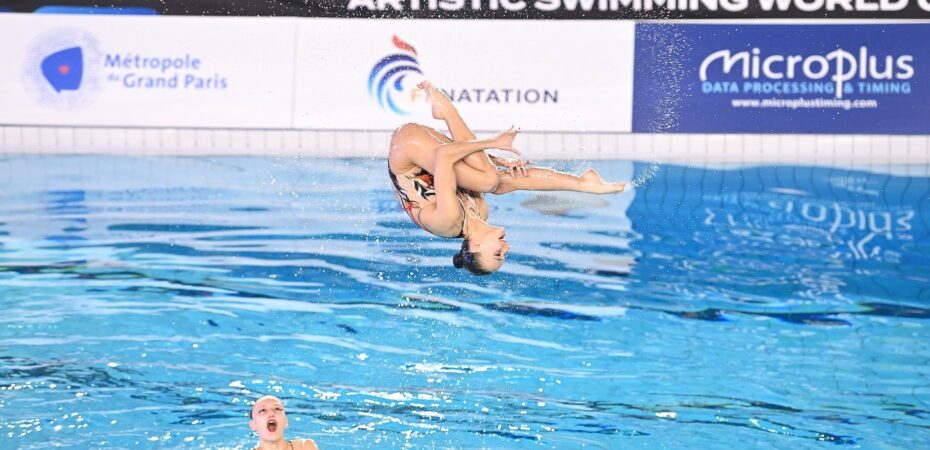
The Paris World Cup is back for another year. And yes, as much as some of us are still emotionally attached to that little detour to Montpellier in 2023 (bring it back, please), there’s something about the French capital.
This is the second stop of the 2026 circuit, following February’s opener in Medellin, Colombia and it runs from Friday, March 27 through Sunday, March 29. Quick heads-up if you’re watching from home: France switches to daylight savings that weekend, so double-check your schedules unless you enjoy missing half a final.
A total of 27 countries are entered, including several leading programs making their first appearance of the season.
Neutral Athletes B will be one of the most closely observed teams in Paris, as this marks their first competition since their major coaching change. As a reminder, seven-time Olympic Champion Svetlana Romashina took over from Tatiana Pokrovskaya last fall, and while some familiar faces remain within the staff, the direction of the program already appears to be evolving.
The previous coaching group — aside from Pokrovskaya — remains involved, but responsibilities have been redistributed, with former junior coaches Daria Alexandrova and Marina Golyadkina stepping into more prominent roles within the senior setup. Both seem to have been given significant creative input, with early signs pointing toward a broader range of stylistic choices and approaches.
Alexandrova has worked on the technical team, opting for what has been described as “vibrant music,” while Golyadkina, a 2020 Olympic champion, is leading the free team. There is particular anticipation around this particular event, which has not been performed by the Russian athletes since 2022, whether domestically or internationally. A brief teaser (!) released ahead of the competition already set the tone, and suffice to say, it is likely to be one of the most closely followed routines of the weekend.
In a recent interview, Romashina still stated that the goal for this World Cup is measured: “to perform at a ‘B’ level and see how the audience and judges react,” adding that “our goal right now isn’t to go out there and give it our all… peaking in March would be wrong.”
From a sporting perspective, Paris serves as a useful step. The program only returned to major international competition at the World Championships in Singapore last July, and many of the athletes are still gaining experience under the current system. There are also additional new faces in the roster compared to Singapore, pointing to a continued phase of renewal and, perhaps, some evolution in team selection procedures. One notable change also concerns the duet swimmers, who are already integrated into the team routines for this meet and therefore presumably no longer training separately.
Overall, Romashina has spoken openly about introducing new ideas to the squad, and there is also a broader intention to gradually reshape training dynamics. In her own words, “we don’t want to rush this process… we want everyone to adapt, especially the athletes,” with an emphasis on creating “a constructive dialogue… so that athletes aren’t afraid to come and say, ‘this is where we’re uncomfortable.’” It is a notable shift in language, even if the long-term objective remains unchanged: maintaining the program’s competitive standard and ultimately targeting gold at the 2028 Olympics.
In terms of entries for the other events, the duet of Mayya Doroshko, Elizaveta Minaeva and Aleksandra Shmidt, is expected once more following its win in Medellin. National team newcomers Kira Cherezova and Valentina Gerasimova, multiple-time national champions for their St-Petersburg club, will also compete in Paris.
The solo events will feature junior athletes stepping into senior international competition, including Valeria Plekhanova and Zakhar Trofimov, both reigning European Junior Champions. Trofimov is also entered in mixed duet with Alina Rumyantseva. The two are reigning two-time European Junior Champions as well in that event.
France will also begin its season in Paris, competing at home with a fairly updated roster following the significant retirements of Olympians Ambre Esnault, Eve Planeix, and Laura Gonzalez. The changes open space for new athletes across routines, and this competition should provide a first indication of how the team is reorganizing.
The host is notably set to compete in the free team event, which it has not presented since the Paris Olympics. France is also entered in the technical team event with both senior and junior squads. The absence of an acrobatic routine is fairly notable, but it is likely where the recent retirements are felt most clearly. In particular, the departure of Planeix leaves a significant gap, as she had been the team’s primary featured swimmer in all acrobatics since 2018.
The duet will be performed by Laelys Alavez and Romane Lunel, who both competed in Medellin, while 16-year-old Carla Pusta will make her debut right off the bat on Friday morning in the technical solo, in her very first senior season after competing at the youth and junior levels last year.
Italy also makes its season debut in Paris, continuing with the same roster that delivered strong results in 2025. As reigning European champions in the acrobatic team event, and with Enrica Piccoli and Lucrezia Ruggiero holding the European free duet title, the team enters all 11 events with a clear emphasis on consistency and staying at the top.
A recent training camp in California with choreographer Anna Voloshyna also suggests ongoing refinement in existing routines rather than major renewal, but the nation could still surprise in a handful of individual routines.
Ukraine will also make its first appearance of the season, competing in acrobatic team and in duet, with the Hrynishina twins representing the nation there. 17-year-olds Mariia and Uliana Hrynishyna notably placed fourth in both duet routines at the 2025 European Junior Championships, and were part of the senior team at the World Championships.
The status of the duet of Daria Moshynska and Anastasiia Shmonina, last year’s senior pair and 2024 World Junior Champions, is fairly uncertain for now. While Moshynska is still part of the team, Shmonina is absent from the roster entirely and was also not present at the recent national championships.
The People’s Republic of China arrives with a presumably “B” team composed largely of younger but very talented athletes, many of whom have competed at the junior and youth World Championships in the last two years. While this remains a relatively inexperienced group at the senior level, it is also one with considerable potential, and one that should be followed closely at this competition.
The Chinese delegation also includes five male swimmers, all of whom have already medaled internationally across age groups and various events.
They are led by 17-year-old Guo Muye, the current vice world champion in free solo, who is expected to be one of the leading contenders in the men’s solos here.
Other teams beginning their seasons in Paris include Greece, Israel, and Czechia, while Kazakhstan and the United States, both already present in Medellin, add further depth to the field.
In duet, the return of Olympic silver medalists Isabelle Thorpe and Kate Shortman for Great Britain in the event is particularly notable and exciting.
The pair resumes competition together after a season during which Shortman stepped away from the pool for academic commitments, while Thorpe made her (very successful) debut in the mixed duet.
They will only compete in the technical routine here, unveiling a new choreography titled “Last Dance” that pays homage to their Olympic swim.
Neutral Athletes A may also present a new duet configuration, with world medalist Vasilina Khandoshka expected to compete alongside Anastasiya Halaukova. It will be particularly interesting to see how this pairing came about and how it translates in the water.
Halaukova has had limited exposure at major international competitions, with her last appearance dating back to the 2021 European Youth Championships, where she competed in the team event.
She was not part of the senior squad for last year’s World Championships but remained active on the junior circuit in 2024, including competitions such as the Federation Cup. She has also participated in various smaller international and “Open” competitions in recent seasons, so while she may be less familiar at this World Cup level, she is not entirely new to international competition.
Also keep an eye on the men’s solo events, where the field is particularly competitive. Besides Guo and Trofimov, the lineup features European Champion Ranjuo Tomblin (Great Britain), world medalists Filippo Pelati (Italy) and Gustavo Sanchez (Colombia), world junior medalist Nicolas Campos (Chile), and Eduard Kim (Kazakhstan), gold medallist in free solo in Medellin and whose interpretation is consistently compelling and engrossing.
On the women’s side, several athletes stand out for the solo events. Germany’s Klara Bleyer, the reigning European champion, and Türkiye’s Selin Hurmeric, vice-world youth champion making her technical solo debut, are both ones to watch.
Enrica Piccoli, silver medalist in free solo at the European Championships, and three-time world medalist Vasilina Khandoshka (NAA), known for her strong personality and expressive interpretation, will also compete. From the USA, Anita Alvarez brings her own distinctive style and artistry to the pool, adding another compelling presence in this lineup.
The mixed duet should also be one of the highlights of the competition. The event continues to deepen internationally, and this field promises to be both competitive and varied in style, making it well worth following across both routines.
The competition starts on Friday, March 27th at 9.30 am local time. All the information to follow the event is available here.
ARTICLE BY CHRISTINA MARMET
Cover photo: Anh Viet Chau / FFN
If you’ve enjoyed our coverage, please consider donating to Inside Synchro! Any amount helps us run the site and travel costs to cover meets during the season.