
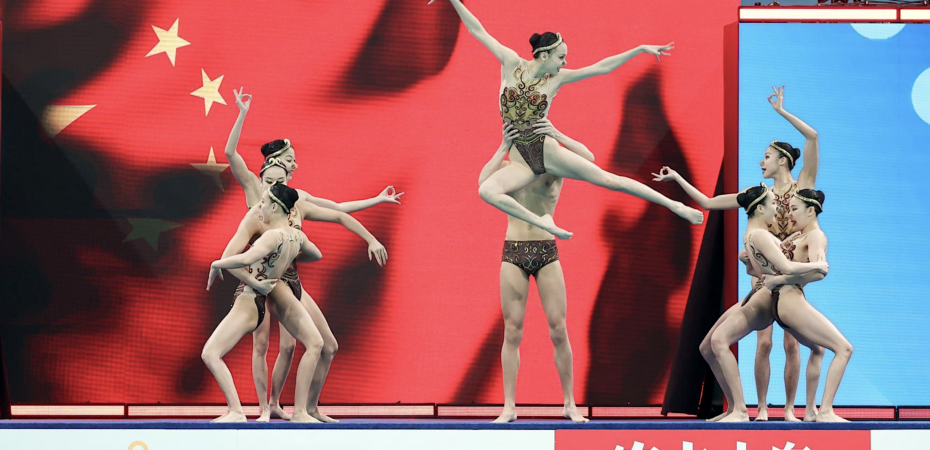
The People’s Republic of China asserted its international dominance at the Xi’an World Cup, collecting five gold medals, three silvers and one bronze on home soil. Yet despite the hosts’ commanding haul, it was far from a complete sweep.
As expected, the Russian Federation emerged as China’s closest challenger with three golds, three silvers and two bronzes, while Great Britain continued its impressive momentum in the mixed duet and men’s solo events, leaving Xi’an with two golds and two silvers. Germany also secured a victory thanks to Klara Bleyer in free solo, who once again confirmed herself as one of the leading names on the World and European solo scene.
For China, there was a sense of continuity rather than reinvention. For the “A” team, the routines remain largely the same as last season, although of course refined and performed with greater difficulty and control.
Xu Huiyan, reigning World Champion in technical solo, continued to look untouchable at the top of the discipline. She showcased her “Lovesickness” routine once more, scoring 263.8634 and demonstrating great precision and interpretation, with the confidence of an athlete fully settled into her role as the world leader in the event.
“The main changes are in the combination and difficulty of some leg movements,” Xu told Xinhua News Agency. “In the past year, I have become more mature mentally and am not as nervous as I was when I first started competing.”
She also reunited with Lin Yanjun in technical duet, the pair earning gold with its “Warrior of Moon Shadow” routine and a score of 308.2983. The two had already competed together at last year’s Xi’an World Cup Super Final, before Lin Yanhan joined her twin sister for the World Championships.
Xu claimed her third gold of the competition – all in one day – in the technical team event. The reigning World Champions retained their status at the top the podium with the now-familiar “Wukong” choreography, taking the top spot with 304.3592.
“In the team technical routine, formation variation is our advantage,” explained Zhang Xiaohuan, head coach of the Chinese team. “We used to have about nine formations, but now we can only [declare] six. To adapt to the rules, we increased the leg movements of our team members, but we didn’t increase their breath-holding time; instead, we improved the efficiency of their movements.”
This routine also symbolized an important evolution for the Chinese program, with Guo Muye becoming the first man to swim within the nation’s top senior team. The 17-year-old took part in the acrobatic team routine as well.
Guo also took gold in men’s free solo with his “The Quest” routine and a score of 263.2338. The reigning vice-world champion in the event continues to grow into one of the discipline’s most compelling soloists, also claiming silver in technical solo and only 0.4166 behind the winner.
Speaking specifically about Guo’s progression, Zhang Xiaohuan highlighted the impact team training has had on his individual development:
“Guo Muye has improved both mentally and technically over the past year, especially after taking on team events. His performance in individual events has become more fluid, composed, and effortless.”
China added another title on the final day of the competition, with the junior pair of Cao Yixin and Shi Haoyue scoring 224.8041 for gold in the free mixed duet.
In the acrobatic team, the reigning World Champions, had to settle for silver after receiving a basemark on one of their platforms in their “Soul of the Terracotta Army” routine.
Finally, the host nation also once again showcased its remarkable depth, with athletes outside the main senior team managing podium finishes, including silver in free team and bronze in the acrobatic event.
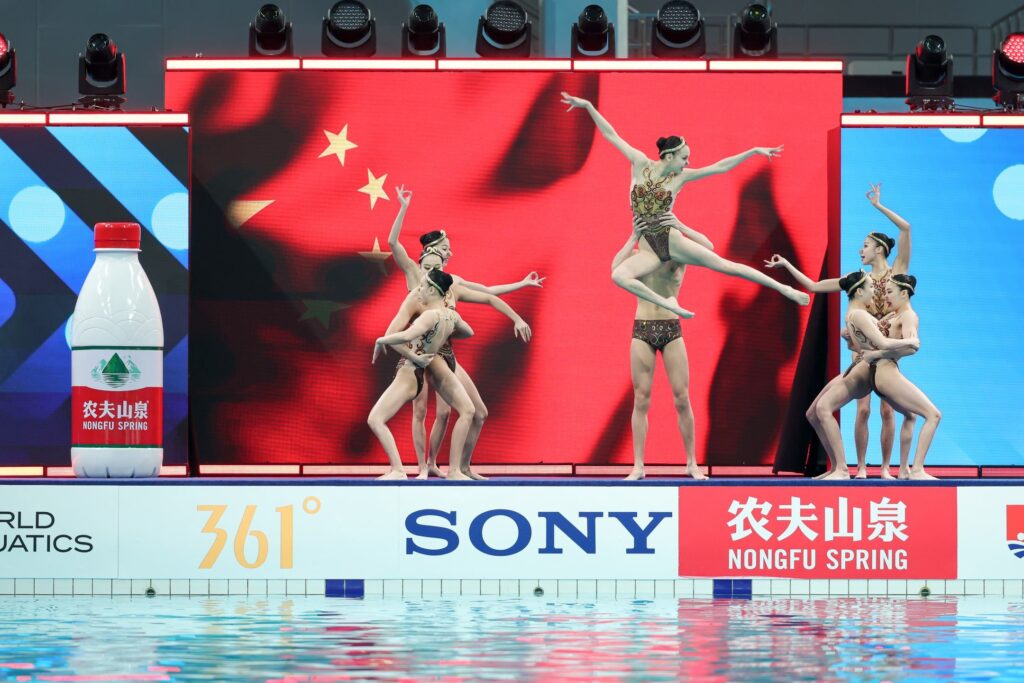
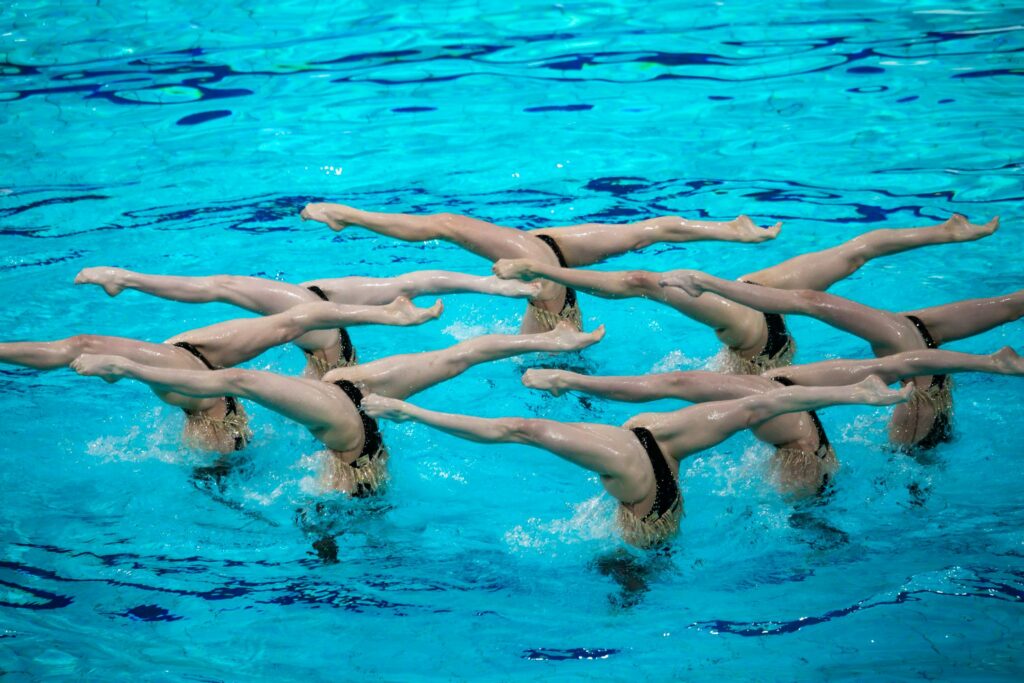
The Russian Federation delivered one of the standout performances of the competition with the debut of its new acrobatic team routine, “Chaos Dolls,” choreographed by Olympic Champion Marina Goliadkina.
The result was immediate success, securing gold with 227.9089 in its first outing and notably earning four perfect 10s, including one in artistic impression for choreography and musicality. The routine from the reigning vice-World Champions already looked remarkably polished, with especially impressive acrobatic execution throughout.
The Balance acro, performed as the second-to-last, especially stood out for both its originality and stability as well. The various throws, and transitions between the different positions during the platforms, were equally solid.
Russia also struck gold in free duet through Kira Cherezova and Valentina Gerasimova and their “Shamans” routine, after the pair had taken silver in Paris. Notably, they carried the second-highest declared difficulty at 67.75, just behind their own teammates, juniors Kristina Chekhanova and Anastasiia Sidorina, who declared 67.80 and claimed silver.
Russia claimed another gold in the free team event thanks to its “Online, not alone” routine scoring 260.0196.
Just like in Paris, this particular result highlighted just how compressed free team scoring currently feels under the recalibrated artistic impression factors. It still feels somewhat odd that an eight-athlete free team routine from a top nation, packed with high difficulty and complexity, intricate choreography and far more elements, barely surpasses 260 points, while a technical duet can comfortably exceed 300. The mathematics explain the discrepancy, but from a visual and structural standpoint, the contrast remains difficult to fully reconcile.
Anyways, in technical team, Russia settled for silver behind China with its “Backstage Romance” choreography. The available live footage unfortunately made detailed analysis difficult, filmed from frustratingly far away, but the overall trajectory remains clear: despite its coaching changes, Russia is still very much one of the top teams and continues inching back toward China.
Another tremendous World Cup outing came from Great Britain, most notably through Ranjuo Tomblin, who leaves Xi’an with two golds and two silvers across his events, the mixed duets and the men’s solos.
Germany’s Klara Bleyer captured gold in free solo with her “Space” routine, scoring 282.8000 and narrowly edging Belarus’ Vasilina Khandoshka by just 0.1849. Khandoshka, however, had the edge in technical solo, taking silver ahead of Bleyer, who settled for bronze. The rivalry between the two is rapidly becoming one of the most compelling storylines on the World Cup circuit, and especially ahead of this summer’s European Championships.
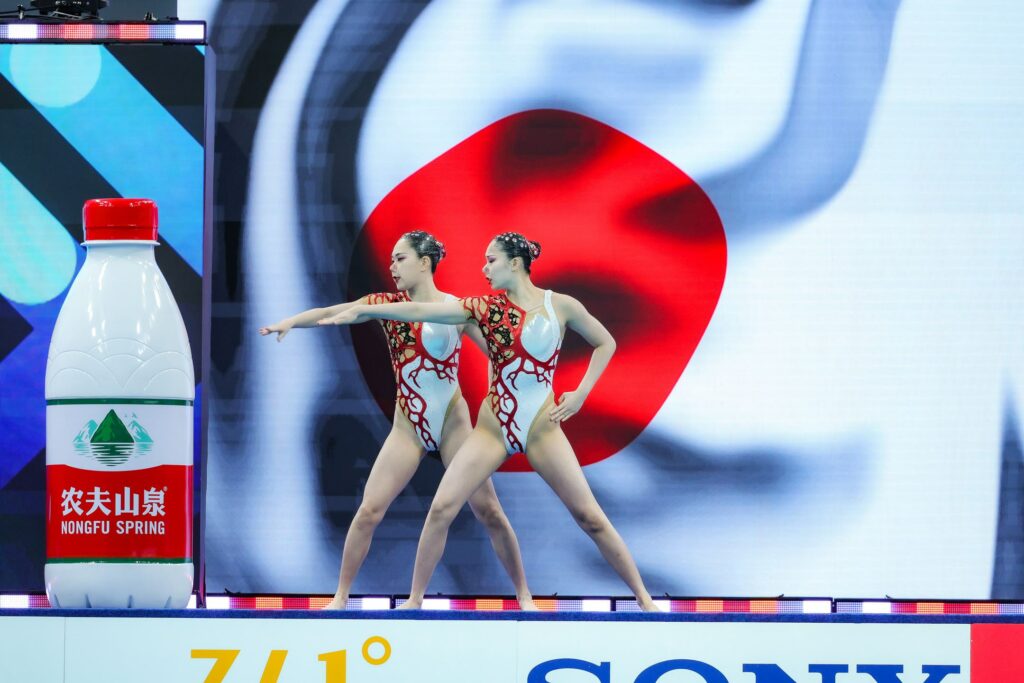
Japan made its first World Cup appearance of the season in Xi’an and left with three bronze medals in technical duet, free duet and technical team, while unveiling several new routines.
The new technical team routine, themed around “No roses without brambles,” earned bronze behind China and Russia with a score of 280.9966. The choreography presented a noticeably different atmosphere and stylistic direction from what Japan has traditionally shown in recent seasons, which made the routine particularly interesting to watch. While there is still room for improvement in terms of height and overall execution, the routine already carries a strong identity and emotional intention.
Olympian Higa Moe returned to technical solo with a new routine set to “Birds of Paradise.” A zero on her opening TRE unfortunately impacted the final score, but it was nevertheless a strong swim and another reminder of the maturity she continues to develop as a soloist. Still only 18 years old, Higa already carries several years of international experience despite her young age, and that growing confidence is becoming increasingly visible in her performances.
Higa also reunited with Sato Tomoka in free duet to unveil a new “Symbiosis” routine for bronze and a score of 283.1905. Although the pair represented Japan in duet at the Paris Olympics, last season they focused only on technical duet together, with Sato instead swimming free duet alongside Kobayashi Uta.
Finally, Japan’s new “Hunters” acrobatic team may have received two basemarks, but the improvement in the acrobatics themselves was impossible to miss. Acrobatics in general had been a weaker area for the nation in recent years, but this routine underlined how much work has gone into addressing that gap and building greater difficulty and stability in the elements. The nation notably worked with Aldo Pantaleoni, a specialized acrobatics coach from Italy, in recent weeks.
Here, the lifts looked more powerful and a lot higher, while the choreography itself felt refreshing and ambitious. This fourth place will no doubt be a disappointment for the squad, but the work is clearly there. With more competition exposure and steadier nerves, the results should follow.
While some athletes and nations were only beginning their season in Xi’an, others continued using the circuit as an important opportunity to gain international exposure and evaluate developing partnerships ahead of the summer’s championships.
Switzerland’s duets, for instance, have now competed at all three World Cup stops this season.
Indeed, the nation is using the World Cup series as part of its broader selection process for the remainder of the year. The Paris and upcoming Pontevedra World Cups, along with the Swiss Championships in April, play a decisive role in determining the athletes selected for the 2026 European Championships in Paris as well as the 2026 World Junior Championships in Budapest.
So while Xi’an – and earlier Medellin – are not part of the official selection pathway, these events still serve as important reference points and offer invaluable competitive experience.
One of the standout Swiss performances in Xi’an came from Anna-Sophia Aeschbacher and Ixchel Honer, who only began swimming together ahead of this season. Working with former Mexican junior national team coach Ariadna Medina, the pair delivered two strong swims over the weekend, placing fifth in free duet and sixth in technical duet.
Switzerland’s duet of Melody Halbeisen and Meret Isler has been navigating a more challenging preparation period, but still managed two basemark-free swims in Xi’an. Halbeisen was once again partnered with Isler, originally the reserve for the long-standing Halbeisen – Aimée Michel pairing, as Michel remained sidelined with a lingering injury.
Indeed, Isler had already stepped in at the last minute for the Paris World Cup, and despite the difficult circumstances, she has integrated seamlessly into the partnership. The pair continues to adapt well under pressure, finishing seventh in free duet and 11th in technical duet here, the latter affected by an unusual timing error.
Xi’an offered again another reminder of how valuable adaptable reserves can be at this level. Germany’s Maria Denisov also stepped into the technical duet alongside Klara Bleyer after Amélie Blumenthal-Haz was ruled out due to health issues, according to broadcast commentary.
The World Cup circuit now heads next to Pontevedra, Spain, for the fourth stop of the season later this month.
ARTICLE BY CHRISTINA MARMET
Cover photo: World Aquatics
If you’ve enjoyed our coverage, please consider donating to Inside Synchro! Any amount helps us run the site and travel costs to cover meets during the season.