
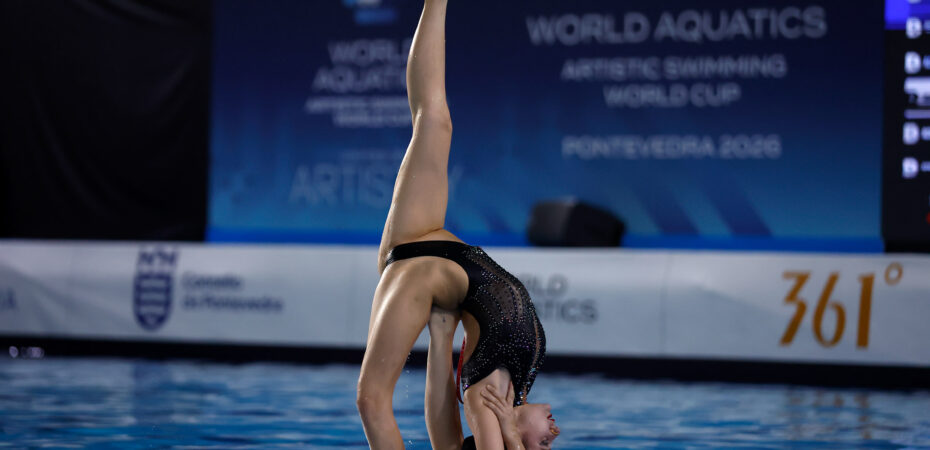
The fourth stop of the 2026 World Aquatics Artistic Swimming World Cup concluded in Pontevedra with Spain topping the medal table on home soil, collecting five gold medals and four silvers.
Great Britain followed with three golds, while Canada, France and Italy each claimed one event title. Colombia, Georgia, Greece, Kazakhstan, Mexico, the United States and Neutral Athlete A’s Vasilina Khandoshka also reached the podium.
Spain’s haul was partly built on the strength of its team events, where the hosts secured two gold medals and one silver while once again showcasing the creative identity that has become a hallmark of the Andrea Fuentes era.
The weekend began with the debut of the nation’s new technical team routine, performed to “Hope” by NF, and which ultimately claimed gold. The reigning European Champions and world bronze medalists arrived with a declared difficulty (DD) of just 39.20, a very bold choice in the current landscape and one that says a lot about the trust this team has in Fuentes’ vision.
For reference, the People’s Republic of China, reigning World and Olympic Champion, and the Russian Federation, reigning vice-World Champion, performed with DDs of 52.3125 and 50.00, respectively, at the Xi’an World Cup a few weeks ago.
It takes a lot of confidence, and perhaps a touch of madness, to go your own way at the highest level. Not to go against the system, but to find a different, constructive path through it. To remain an active participant in the sport’s evolution for the greater good, rather than simply follow where it is going and accept the idea that there is only one viable way to succeed.
It was undeniably a risky bet, but the routine delivered on all fronts. The opening cadence hybrid (a real cadence!) built perfectly with the music, the execution on the Technical Required Elements was superb and never dropped throughout the swim, and the final hybrid was simply explosive.
While most others are nowadays often barely hanging on by the end, the Spanish athletes clearly had a lot left in the tank, finishing with the kind of conviction and intensity that leaves a lasting impression long after the routine is over. The kind of energy perhaps nobody had even realized the sport had been missing all along, until now.
What made the swim even more memorable was the feeling of watching a team that had fully bought into the vision. Every swimmer looked committed, performing with confidence and intent rather than caution and fear. At the end of the day, this entire routine had a sense of purpose and clarity that was, honestly, very moving. And, well, hopeful. Chapeau.
Also, who would have thought Fuentes’ first team 10.0s in Choreography and Musicality would come with a technical routine?
The debut of the much-anticipated acrobatic routine, “Berghain,” was just as spectacular, albeit for different reasons, and nearly produced a perfect ending to the entire competition. The squad delivered an outstanding swim packed with ambitious, intricate and at times seemingly impossible acrobatic elements, paired with a fantastic choreography and an incredibly engaging performance.
Unfortunately, disaster struck in the closing seconds when the final acrobatic move failed, resulting in a basemark and relegating the hosts to silver. The swimmers still repeated their last acro after the routine concluded so spectators could see the intended version, but it of course could not count for the final score.
Despite the setback, the routine already demonstrated its enormous potential and innovation. If anything, this result should only add motivation heading into the European Championships in Paris.
It was also wonderful to see Spain field two teams in that event and provide an opportunity for the entire senior national team group to perform in front of the home crowd. The “secondary” squad understandably showed slighly less consistency on some of the acrobatics, but it highlighted the depth of the program and allowed different swimmers to take on featured roles.
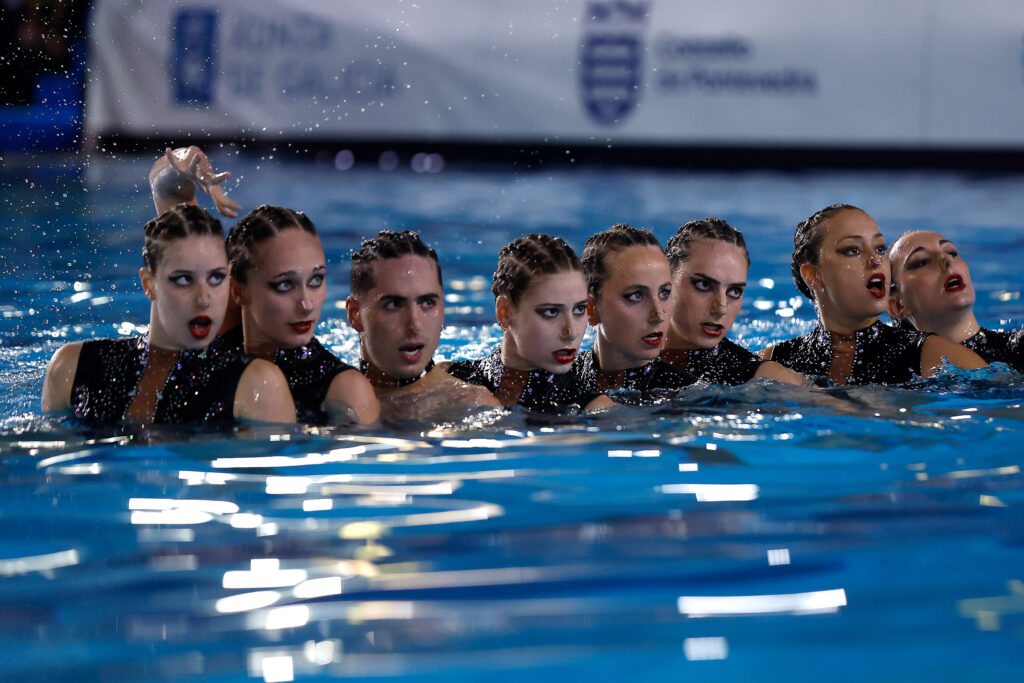
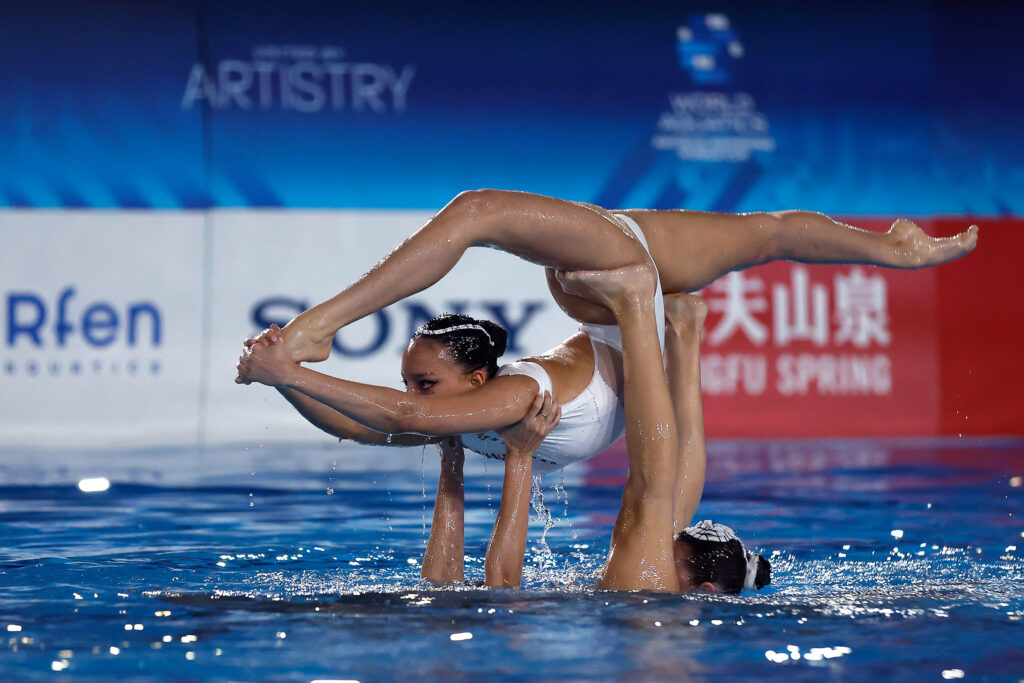
Spain claimed gold in the free team event with “La Locura,” the same routine that earned them the European title and a world bronze medal last season. Even with a basemark on one hybrid, the team remained comfortably ahead thanks to a strong artistic impression score and another convincing performance.
The nation also found success in the duet and solo events, unveiling a pair of new routines. World Champions Lilou Lluis and Iris Tio captured gold in the free duet with a score of 297.2209 on their “Essence of Femininity” choreography, continuing the success of the routine that carried them to the world title last season.
The pair also unveiled a new, lovely technical routine set to Vivaldi’s “Spring” for their first time competing in this event together. Unfortunately, they received a basemark on their opening hybrid due to incorrect unbalanced positions, which ultimately dropped them to fourth place. Even so, this ranking already highlighted the routine’s potential, as it still remained extremely competitive while effectively ending with a DD of about 17.
Iris Tio added two more gold medals to her collection in solo. The world bronze medalist won the technical event with her new, heartfelt routine to Rosalia’s “Mio Cristo Piange Diamanti,” scoring 262.8650. In the free solo, she remained unbeaten with her world championship-winning “Hymne à l’Amour” program, earning 268.7725.
Spain’s technical mixed duet also provided one of the pleasant surprises of the weekend. Eneko Sanchez and Carla Lorenzo captured silver despite having trained together only about six times before the competition. While Lorenzo trains year-round with the senior team, Sanchez is still only in the junior national team. Yet, the two finished right behind the experienced and world medalist duo of Great Britain with their “Hip Hop, Let’s Go” routine.
Sanchez in particular enjoyed a remarkable senior international debut here. At just 16 years old, he collected two more silver medals in the men’s solo events against a field that included European Champions and world medalists, demonstrating consistency and poise well beyond his years.
France left Pontevedra with three medals out of three possible events, earning one of each color. The duet of Paris Olympians Laelys Alavez and Romane Lunel continued its impressive season by winning technical duet gold with its “Heart” routine, and taking silver in free duet with the “Octopus” choreography.
Their win in the technical event, achieved with a score of 291.1000, marks France’s first-ever World Cup gold medal under the current format. And obviously, it also provides significant momentum ahead of the European Championships on home soil and a return to the Paris Olympic pool.
France’s bronze medal in technical team may have been one of the most hard-earned results of the competition. While details remain unclear, the lineup suggested the team faced significant, last-minute challenges in its preparation.
Rising talent Carla Pusta was absent from the competition after clearly playing a key role as the team’s new flyer and soloist at the Paris World Cup, and veteran Claudia Janvier was also missing. Esteban Collet, who served as reserve in the Paris World Cup, was not part of the roster either. As a result, France effectively had to call on the reserve of the reserve simply to field enough people for this routine. Yet, the team managed to pull everything together and secure a podium finish, a huge credit to the athletes’ resilience and adaptability.
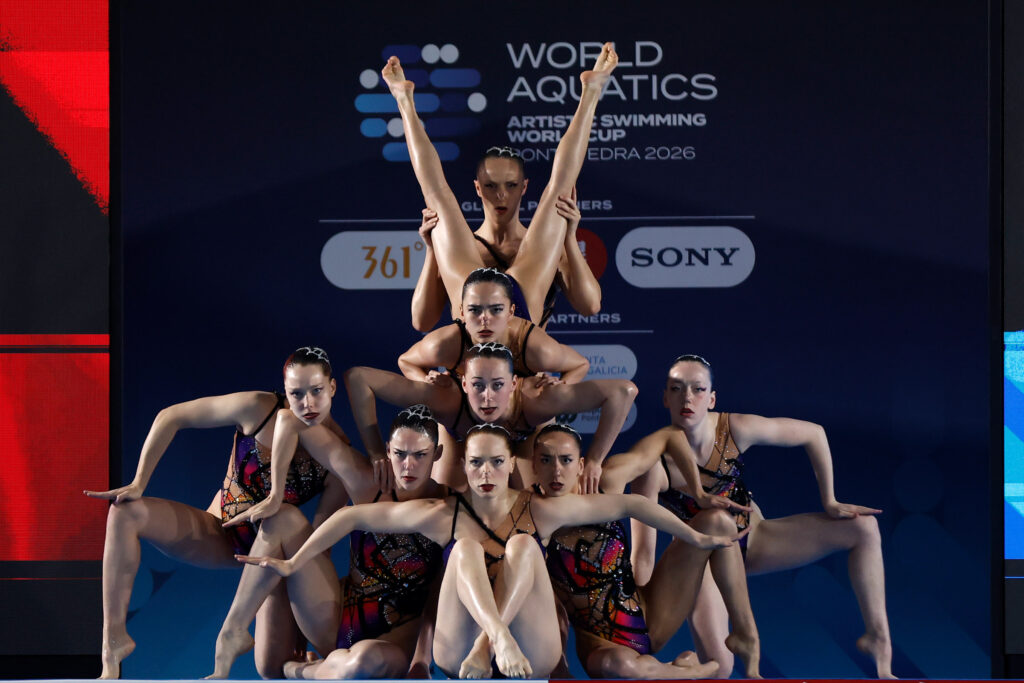
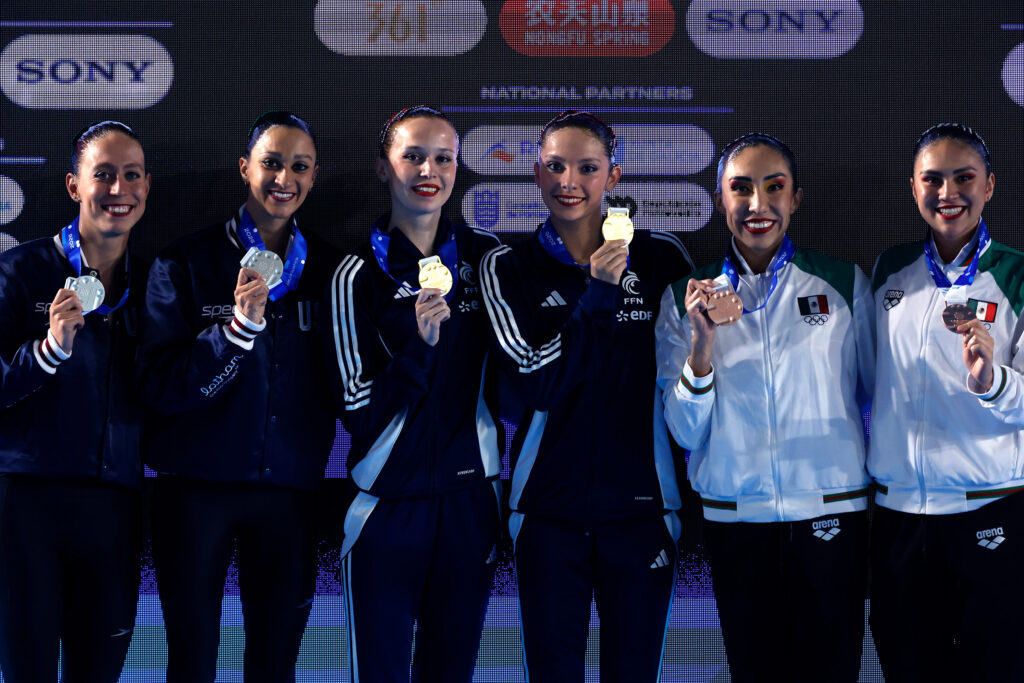
Canada also had a very successful trip to Spain, departing Pontevedra with gold in acrobatic team and bronze in free team. The returning “Spider” acrobatic routine, first introduced last season, was delivered with excellent execution and impressive, steady acrobatics. New featured swimmers Andrea Escobar and Charlie Breault stood out throughout the performance, with the former playing a major role in several, sky-high airborne jumps on the way to helping the nation claim the event title with 217.2892 points.
In the free team event, the Canadians unveiled their new choreography to the theme of “Cosmic Creatures Visiting Space,” marking the nation’s first appearance in the event since the Paris Olympic Games.
For the United States, Anita Alvarez and Jaime Czarkowski showed they are slowly but surely establishing themselves as one of this season’s emerging duet on the international circuit.
The team vice-Olympic champions earned silver in technical duet here swimming to “Dream On” by Aerosmith, and finishing just 0.5184 points behind the French pair. They also debuted a new free duet to Florence + the Machine’s “Breath of Life,” placing fourth in their first outing together in this event.
While both athletes have years of experience swimming alongside one another in team competition, this is only their first season as a duet. Still, their partnership already looks well balanced and competitive, and clearly one to keep an eye on in the future.
Alvarez also deserves recognition for her free solo performance, her first time in the event since the 2024 Paris World Cup. Like Spain in technical team, she had opted for a significantly lower DD, actually beginning with the lowest in the entire field at 40.60.
Swimming to the theme of “I Am Human,” Alvarez produced one of the more polished and captivating performances of the event, combining exceptional height and execution with the third-highest artistic impression score. Her execution marks actually felt surprisingly conservative given the quality of the swim – at this point one wonders if she would need to start levitating to break into the 9s –, but the routine nevertheless left a very strong impression, ultimately resulting in a top 10 finish.
There was something particularly enjoyable and refreshing about seeing a swimmer lean so fully into her own artistic voice. In an event where nearly everyone is chasing more difficulty, Alvarez reminded us that there is still room for solos built around self-expression and storytelling, around emotion and intentionality. She was simply out there sharing her art in the water, letting the performance unfold on its own terms, with the result, whatever it may be, feeling secondary to the message being delivered.
Greece only competed in two events in Pontevedra, unveiling new choreographies in both. In the acrobatic team, the young Greek squad claimed bronze with a strong swim of their routine built around the horror movie “It”. The result provided a positive conclusion to the competition after what likely was a disappointment in the free team event, where the nation’s new “Hypnosis” routine received four basemarks.
Georgia’s Maria Alavidze was another athlete to celebrate in Pontevedra. She captured bronze in free solo, the second World Cup medal of her career, and delivered a clean technical solo after several competitions in which the routine had proven troublesome. The reward was a fourth-place finish and a well-deserved confidence boost heading into the European Championships.
Finally, another highlight was the team of Chile, which continues to build momentum as one of the sport’s most promising emerging programs. The nation placed fourth in both acrobatic team and free team, ninth in technical team, and perhaps most importantly completed all three events without a single basemark. The “Tango” free routine was particularly memorable, and highlighted a team whose steady progress is becoming increasingly difficult to ignore.
The 2026 World Cup circuit now moves to Toronto, Canada, for the final stop of the season and the Super Final, scheduled for June 19-21.
ARTICLE BY CHRISTINA MARMET
Cover photo: Simone Castrovillari / RFEN – World Aquatics
If you’ve enjoyed our coverage, please consider donating to Inside Synchro! Any amount helps us run the site and travel costs to cover meets during the season.