
Paris 2026 delivered exactly what artistic swimming fans could have hoped for. Over six days of competition at the Olympic Aquatic Centre in Saint-Denis, Europe’s best produced one of the most competitive editions of the European Championships in recent memory.
Gold medals were regularly decided by razor-thin margins, routines reached an exceptional standard, and nearly every final remained undecided until the very last score appeared on the board.
The competition
Perhaps the biggest surprise came atop the medal table, where Great Britain finished first with four gold medals and one bronze; the nation’s first time leading the European Championships medal standings since 1983.
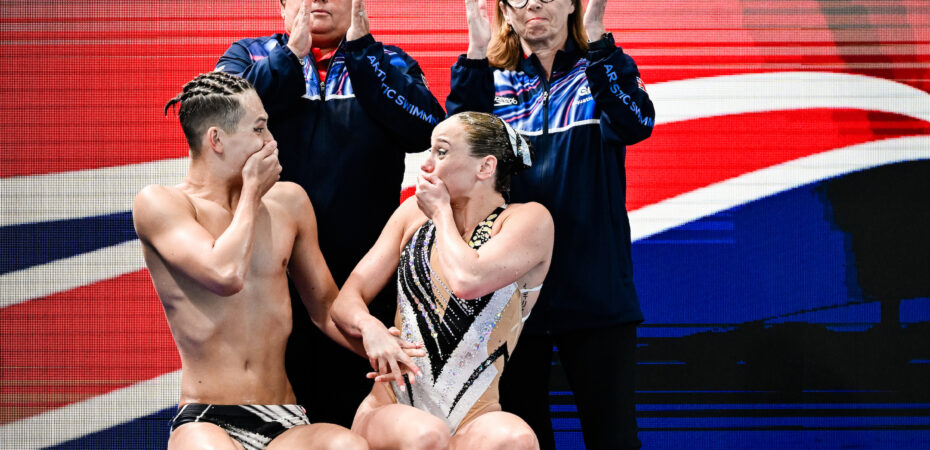
At the center of it all was Ranjuo Tomblin, who delivered one of the standout performances of the competition. Entering Paris as a heavy favorite after an incredible World Cup season, the Brit left with four gold medals from four events.
In a dominant fashion, Tomblin swept both men’s solo titles as well as both mixed duet events alongside Isabelle Thorpe, who actually captured her first European golds despite a decade of competing at the highest international level.
The two once again demonstrated why they have become the benchmark in mixed duet this season, etching their names into the record books by delivering Great Britain’s first-ever European titles in the event and completing the nation’s collection of European crowns.
Yet their emotional post-swim interviews also carried a bittersweet note, as both hinted that Paris was likely their final competition together for a while, with Thorpe now expected to dedicate herself fully to the women’s duet alongside Kate Shortman ahead of the LA 2028 qualifications.
Spain, meanwhile, showcased its incredible depth by claiming the Championships Trophy, awarded to the nation accumulating the highest number of points across all events. With eight medals – one gold, five silvers and two bronzes – across 11 events, Spain proved it remains the most complete artistic swimming nation in Europe.
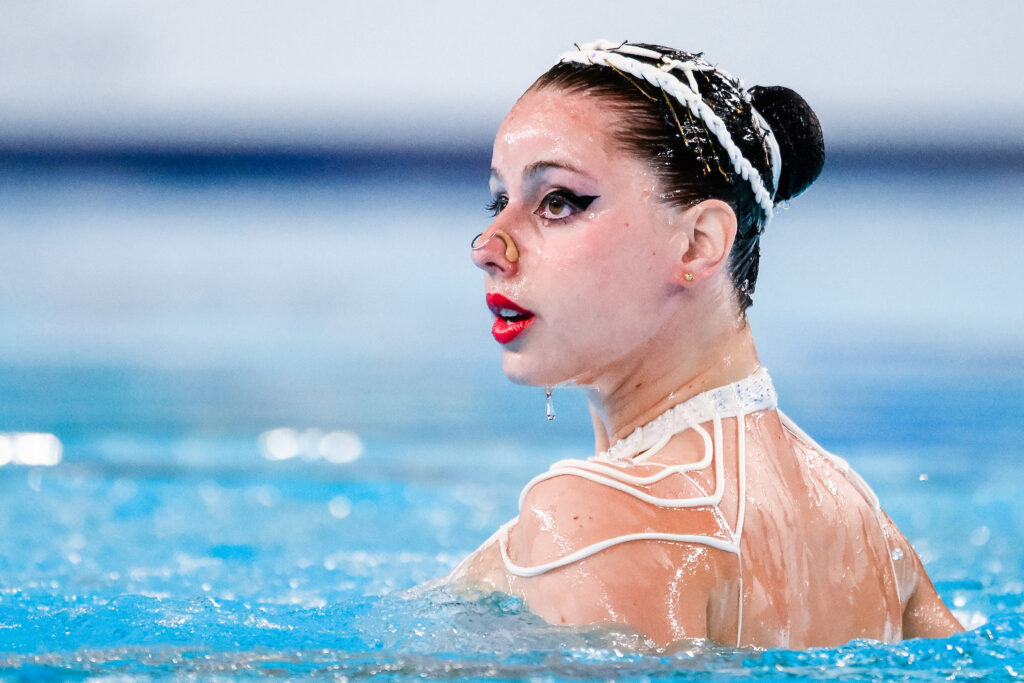
Its lone gold came courtesy of Iris Tio, who finally captured her first European solo title in the women’s technical event. Her emotional routine to Rosalia’s “Mio Cristo Piange Diamanti” was a masterclass in interpretation and emotion, reminding everyone that artistic swimming is about far more than difficulty and even technique. Sometimes, a perfectly timed pause, a piercing gaze or the smallest facial expression perfectly timed to the music can be just as powerful as the hardest hybrid.
Tio edged Vasilina Khandoshka by just 0.2433 points there to secure the title before ultimately finishing as the most decorated female artistic swimming of the championships with six medals.
Entering Paris as the defending champion in five events, Spain came agonizingly close to retaining several of its titles throughout the week. In the free mixed duet, for example, Dennis Gonzalez and Iris Tio ultimately had to settle for silver behind the unstoppable British pair by just 0.265 points.
With Gonzalez still working his way back following shoulder surgery, the Spaniards were unable to maximize the routine’s difficulty, yet they once again delivered one of the competition’s most memorable performances.
Like their rivals, they also suggested that Paris could mark the end of their partnership for now as both begin turning their attention toward Olympic qualification.
Competing under the Neutral Athlete designation, Vasilina Khandoshka made a spectacular return to the European Championships, earning a gold and a silver in her two solo events.
The Belarusian athlete notably produced a magnificent free solo to claim her first European title. Swimming to the theme of “Silent Scream,” her routine showcased her trademark fluidity and effortless movement through the water, disguising an impressive 62.35 DD behind a captivating performance that held the audience’s attention from start to finish.
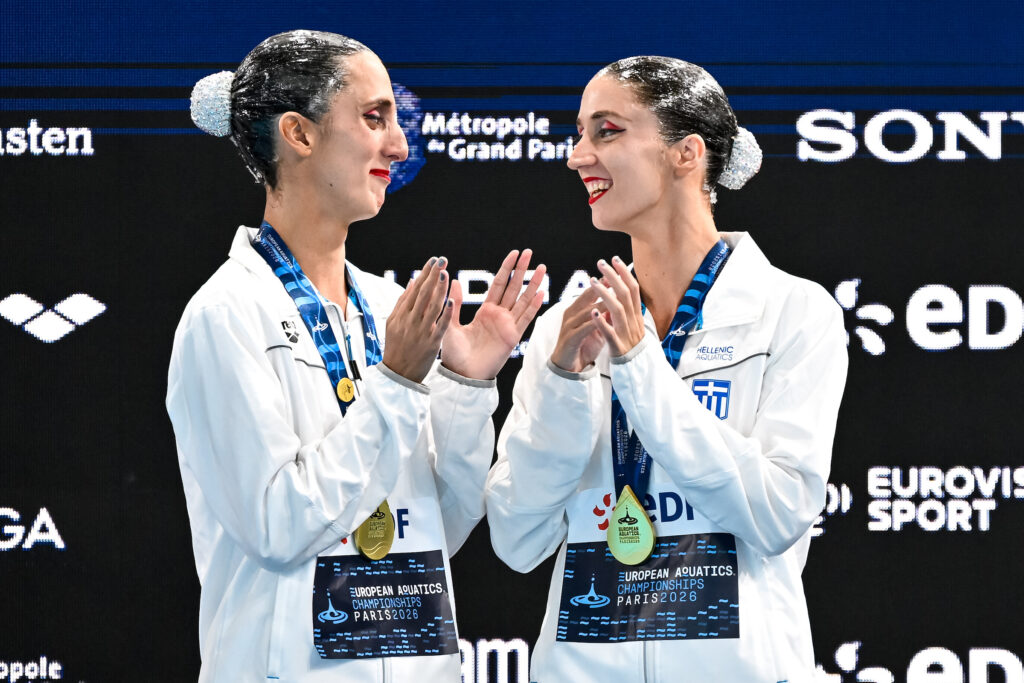
Another welcome return came from Anna-Maria and Eirini Alexandri, who made their debut under the Greek flag after representing Austria throughout most of their international careers.
And what a return it was as they claimed Greece’s first-ever European duet titles, with gold in both the technical and free events, with the latter marking their first competition in the event since the Olympic Games.
Swimming for the first time this season, the triplet sisters successfully defended their European technical duet title with their “Swan Lake” choreography, and unveiled a new “Story of Two Vampire Sisters” free routine.
After placing second in the preliminary round there, the pair produced a much stronger swim in the final, combined with a higher DD, to edge the reigning World Champions from Spain by less than a point.
In the team events, the Neutral Athletes B proved untouchable.
Claiming all three team gold medals, the Russian athletes immediately reminded everyone why they have defined the discipline for so many years.
Their technical precision, synchronization and execution remained unmatched throughout the championships. Their “Backstage Romance” technical routine was outstanding from start to finish, while their “Weird Dolls” acrobatic team performance showcased near-flawless execution across the board.
Yet what made these victories particularly fascinating was also through the challenge mounted by Spain. More than the scores and gaps themselves, this competition highlighted that two very different philosophies and schools of artistic swimming can coexist at the very highest level while constantly pushing each other forward.
While the same three nations occupied every team podium, the gap between the top two continues to narrow, or at the very least remain stable compared to the 2025 World Championships, like in the technical team event despite Spain entering with a declared difficulty more than 10 points lower.
Then, the free team title was decided by fewer than three points, while the spectacular acrobatic team final came down to just 2.4. There, and in front of a packed Olympic Aquatics Centre, Spain and NAB produced one of the highest-quality contests of the week, with Spain’s “Berghain” masterpiece choreography earning nine perfect 10s, including six for Artistic Impression, while the Russian squad collected seven perfect marks for its impeccably executed routine and acrobatics.
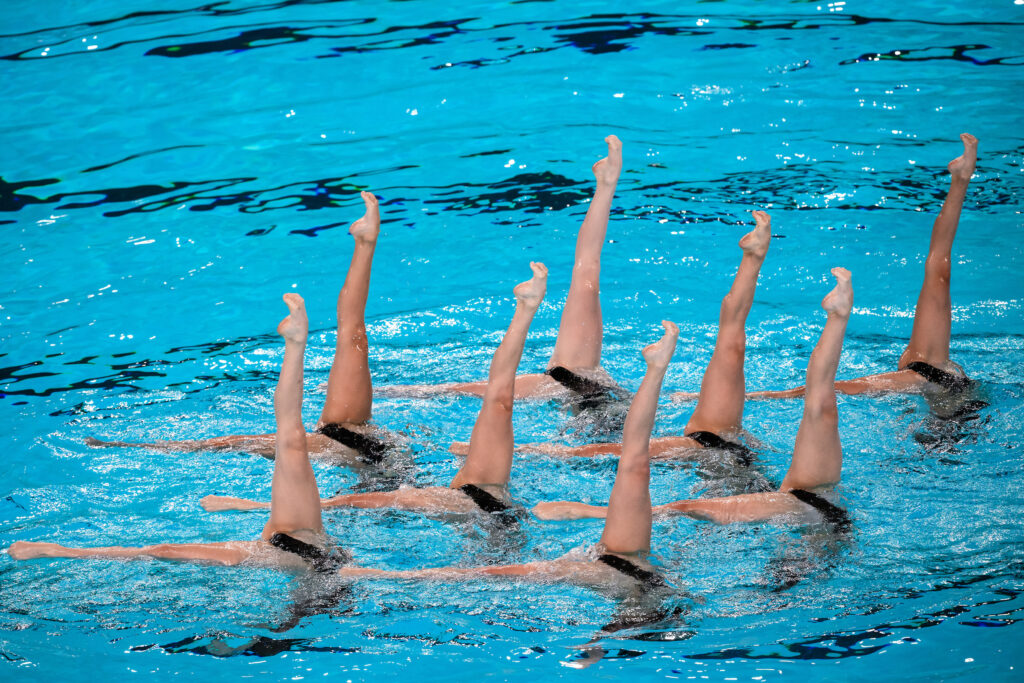
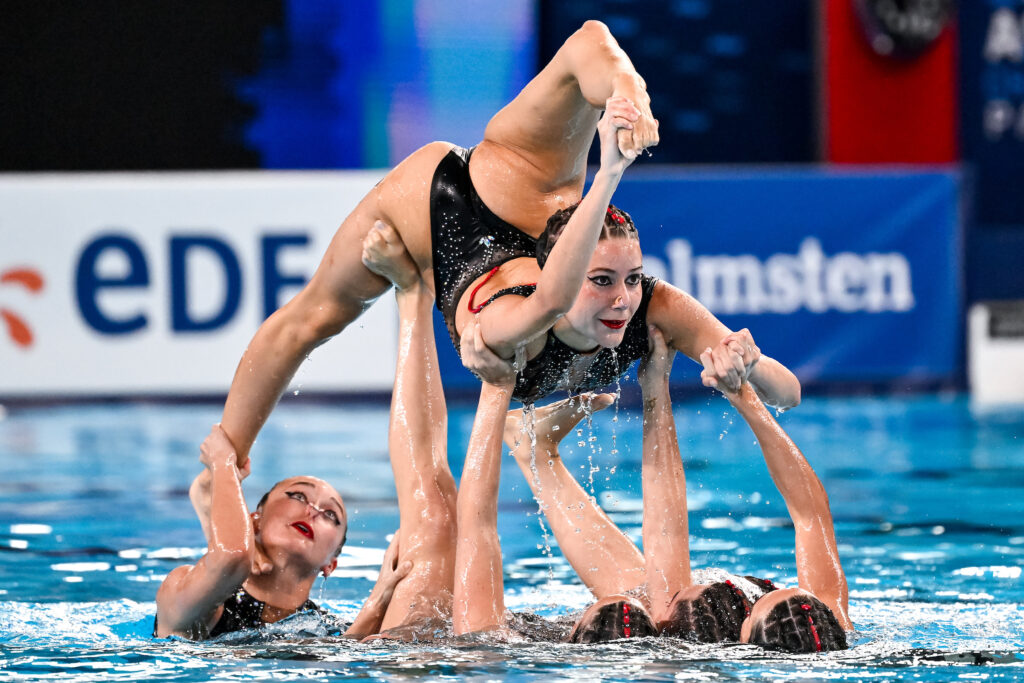
The exciting rivalry extended beyond the team events. Spain had the upper hand in the free duet, with the reigning World Champions finishing more than five points ahead of NAB, while the technical duet ultimately swung the other way after Spain received a costly basemark.
Finally, Spain’s silver medal in the acrobatic team also marked the final international performance of veteran Paula Ramirez. A two-time Olympian, Olympic bronze medalist and now 10-time European medalist, the Spaniard brought an end to an illustrious international career spanning well over a decade, sharing an emotional celebration with her teammates after her final routine.
Italy, meanwhile, reinforced its status as one of Europe’s most consistent artistic swimming nations as well. Competing in all 11 events, the Italians were always in medal contention and ultimately came away with seven medals, three silvers and four bronzes.
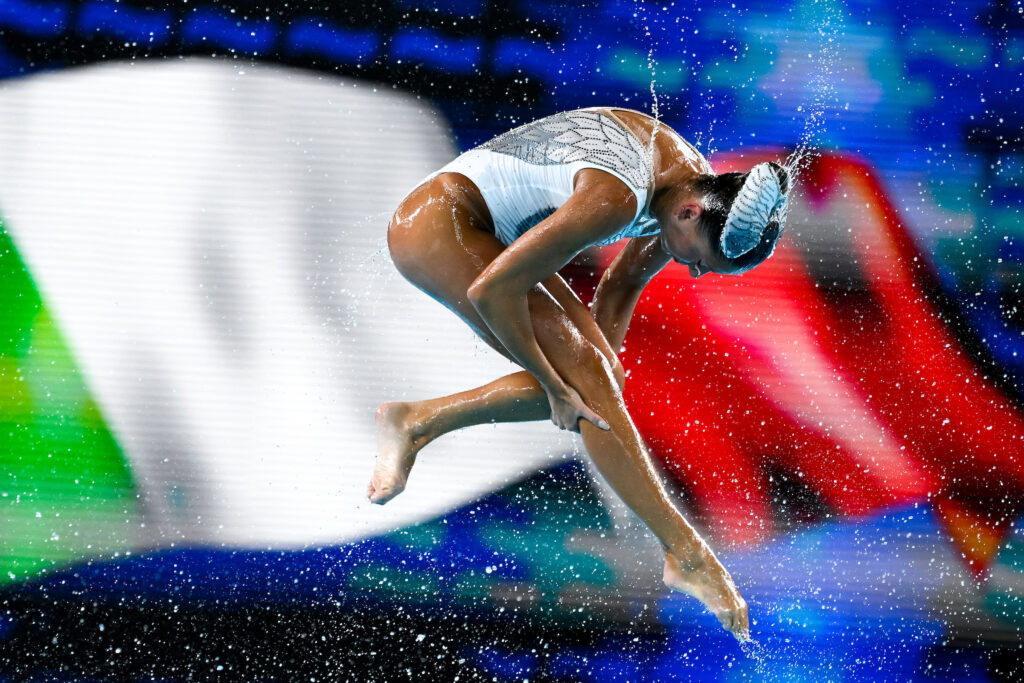
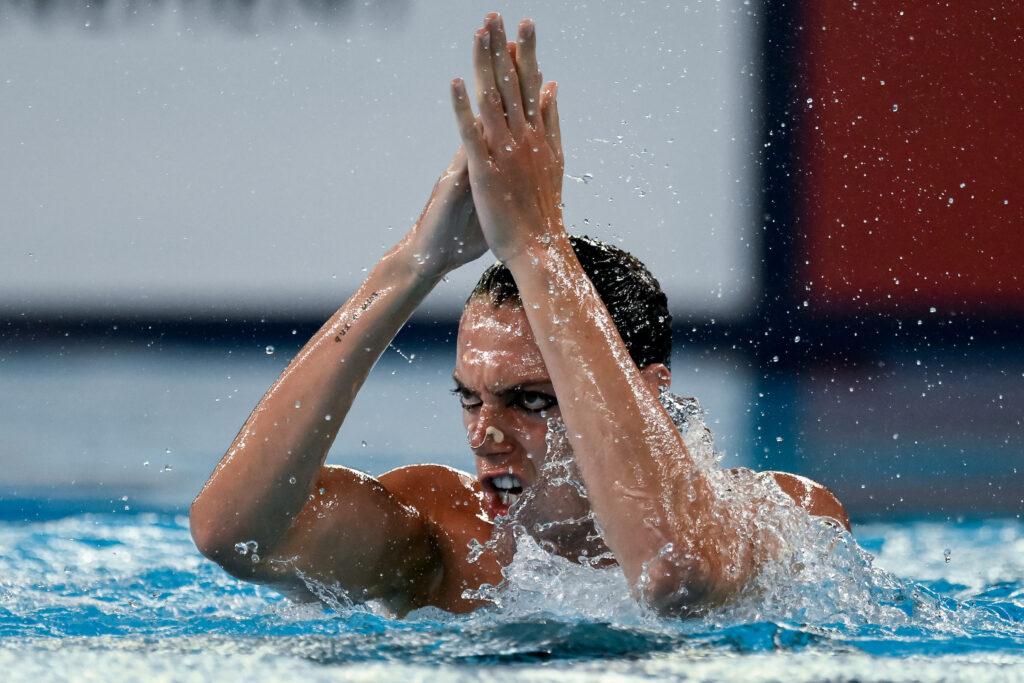
19-year-old Filippo Pelati enjoyed an outstanding championships with four medals of his own, collecting silver in both men’s solo events and alongside Lucrezia Ruggiero in the technical mixed duet, where the pair finished just 0.6691 points behind Great Britain, and a bronze in the free mixed duet.
Germany also leaves Paris with plenty of positives. Klara Bleyer added two more European medals to her collection with silver in the women’s free solo and bronze in the technical event.
Meanwhile, the nation’s newly formed duet of Bleyer and Maria Denisov continued to grow and to offer promising signs for the seasons ahead. Just a few months into their partnership, they finished sixth in both duet events, with Denisov showing remarkable progress in a very short span of time as she continues to settle into her new role alongside one of Europe’s top athletes.
France competed in only four events but finished inside the top five in every one of them, notably coming within just three points of a podium in the technical duet. Laelys Alavez and Romane Lunel continue to establish themselves as one of Europe’s most exciting new duets, combining strong technique with great artistry and an unmistakable French flair in their choreography.
Finally, at just 17 years old, Milan Violon became the first male artistic swimmer to compete in a team routine for France at a major championship, helping his country to fifth place in the free event. It should have been solely a moment of celebration, and one that was deservedly covered by the French media. Unfortunately, it was quickly tainted by a wave of hateful, homophobic comments and cyberbullying on social media.
There is no place for that kind of hatred in sport, and Inside Synchro will always stand with Milan and every boy and man who faces this kind of reaction while breaking barriers and following their passion.
All in all, if Paris 2026 taught us anything, it is that Europe’s artistic swimming landscape has rarely been stronger and so competitive.
The elephant in the pool
Okay, let’s get to it.
In the free team preliminary round, Spain unveiled a “Chaos Hybrid,” which quickly became the talking point of the competition.
Built around a factorisation loophole, all eight swimmers perform different movements simultaneously, creating something as hectic as it sounds, almost impossible to follow, and yet worth an enormous degree of difficulty under the current rules.
Love it or hate it, Andrea Fuentes and her staff identified a weakness in the code and exploited it brilliantly. Better yet, it actually fit perfectly within their aptly named routine, “La Locura”.
Then, the next day in the final, the Neutral Athletes B completely changed their last hybrid to replicate the same concept, with their own Chaos Hybrid subsequently increasing their DD by more than five points.
First, credit where it is due. Both Spain and NAB have done the sport a favour by exposing just how significant and preposterous this loophole is.
Because, what exactly are we rewarding here? A hybrid with virtually no synchronization can receive such a high value? A concept that another team can incorporate into a routine in less than 24 hours can suddenly become one of the most valuable elements?
If the rulebook rewards something, sooner or later somebody is going to exploit it. Spain just happened to be the first to see it.
But the fact that another team could replicate it so quickly also raises legitimate questions about whether the current valuation truly reflects the complexity, preparation and execution the code is supposed to reward.
It also highlighted that judges and controllers have very little precedent for evaluating this type of movement. Realistically, it would only have taken one of these panels to decide that their job becomes impossible when dealing with such a hybrid, and shut it down immediately.
From a purely competitive perspective, NAB’s decision is understandable. At this level, every team looks for every possible advantage, so if your direct rival discovers a way to increase its scoring potential, why wouldn’t you respond?
But two things can be true at once. It was absolutely the right strategic decision if your objective is winning. But it also left many people feeling deeply uncomfortable and indignant.
Artistic swimming is, despite what the current rules sometimes suggest, still supposed to be an artistic sport. Yes, difficulty has become increasingly important, but the sport still relies on creativity, originality and innovation.
Copying trends over the course of seasons, or even from one meet to another, is nothing new. Every successful innovation eventually inspires others. But seeing the core concept of a rival’s innovation so blatantly replicated and appear in the very next round of the very same competition was honestly shocking and provocative.
Where is the line between adapting to the rules, and so openly reproducing someone else’s idea?
The definition of ethics, sportsmanship, and simply winning, will likely always vary from one coach to another. Some will argue that if something is allowed by the rulebook, it is simply part of the game; you don’t win by willingly ignoring opportunities that are there. Others will argue that, even within the rules, there are still lines you can choose not to cross, because how you win matters just as much as winning itself.
Moreover, did NAB actually need to do this? Their “Online, Not Alone” routine was, by every other measure, exceptional. The execution, height, precision, speed, choreography and technical quality were outstanding from beginning to…well, almost the end. But instead, what should have been remembered as an extraordinary performance ended with everyone talking about one, honestly sloppy, hybrid and ending.
But, in a way, a point was made. How very Khandoshka-Doha-2024 of them.
If there is one silver lining for Spain, it is this: imitation remains one of the highest forms of recognition.
Whether one agrees with what happened or not, the ethics of it, or the message behind it, the fact that another title contender – one that actually was leading in the preliminaries – felt so compelled to respond immediately to Spain’s idea is, in itself, a remarkable acknowledgement of the work Andrea Fuentes and her staff have done.
More than anything, it shows that Spain has become the team leading the conversation around innovation. From the very beginning, Fuentes has not just adapted to the new rules, but she has studied them, understood them and built entire strategies and memorable routines around them in ways nobody else has.
And, at the end of the day, Spain has become the team everyone is watching, quite literally. That, perhaps more than any gold medal, is the clearest sign of the influence and leadership this nation now brings to the sport.
ARTICLE BY CHRISTINA MARMET
Cover photo: Andrea Masini / Deepbluemedia
If you’ve enjoyed our coverage, please consider donating to Inside Synchro! Any amount helps us run the site and travel costs to cover meets during the season.
I feel like Vasilina’s historical pivoting overnight to R7 is a different story than Russia just ripping off Spain’s original crazy hybrid concept (I’d really like to see that Coach Card). This whole situation definitely needs its own article.